Boiler Pressure: What It Should Be
In short
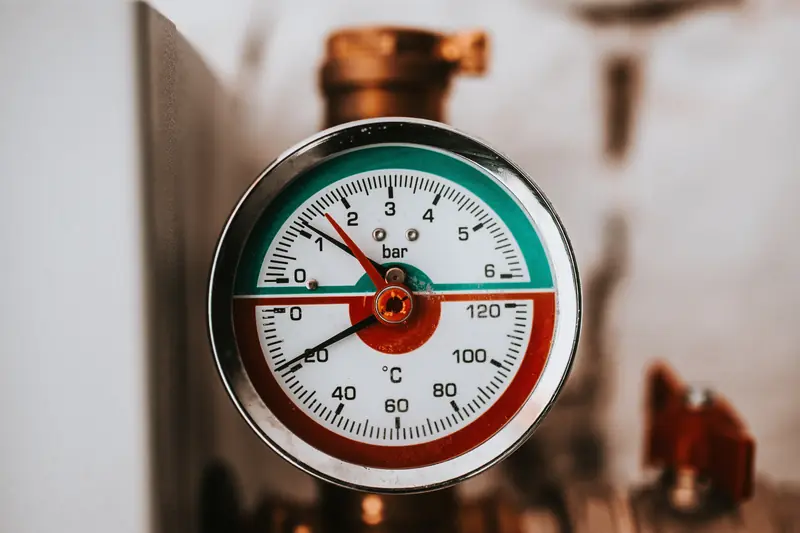
Boiler pressure on most sealed systems should read about 1 to 1.5 bar when cold and stay under about 2.5 bar when hot; check your own boiler's manual, since makers word it differently.
Chalk & Cistern notes · checked and updated
On this page
In brief
- Baxi's 400 Combi 2 user guide asks for 1 to 1.5 bar with the system cold; Worcester Bosch stops filling between 1 and 1.5 bar.
- Worcester Bosch says re-charge if the display reads less than 1 bar.
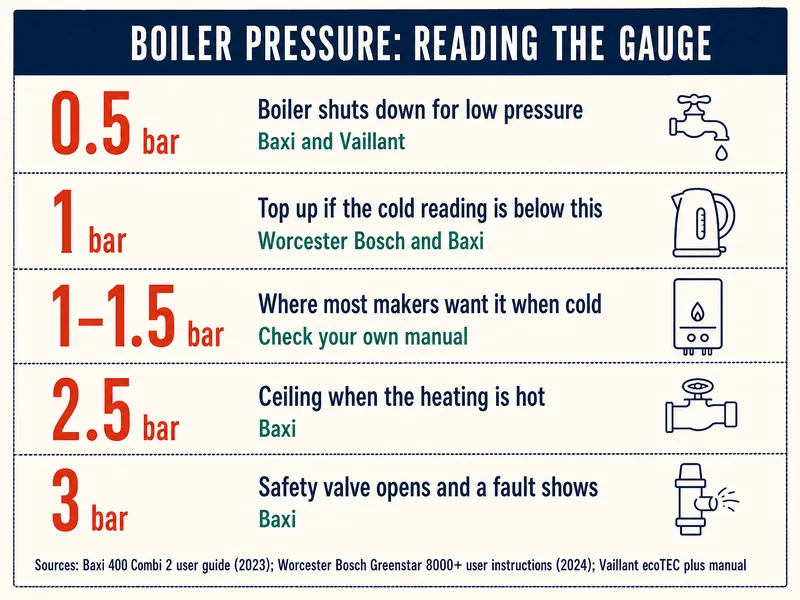
- Below about 0.5 bar Baxi and Vaillant boilers switch off and show a fault.
- Baxi says hot pressure "should not go higher than about 2.5 bar", and its safety valve operates above 3 bar.
- Needing to top up again and again points to a leak, according to both Baxi and Worcester Bosch.
- Topping up through the filling loop is a user-manual job; anything inside the casing is for a Gas Safe registered engineer.
What should boiler pressure be?
Most makers ask for about 1 to 1.5 bar when the heating is cold. Baxi's 400 Combi 2 user guide says to check "with the system cold" that the display reads "between 1 - 1.5 bar", and Worcester Bosch's Greenstar 8000+ user instructions tell you to stop filling when "the pressure is between 1 and 1.5 bar". Read the cold figure, because pressure rises as the water heats and expands.
Some makers quote a wider band. Baxi's pressure FAQ calls 1.0 to 2.0 bar normal and says the needle should stay in the green section. Vaillant's ecoTEC plus storage combi manual gives a cold filling pressure of 1.0 to 2.0 bar and notes that a multi-storey building may need more. That is why your own manual wins over any general figure, this one included.
At the top end, Baxi says hot pressure "should not go higher than about 2.5 bar", and Vaillant lists a permissible operating pressure of 2.5 bar. At the bottom, Vaillant's display flashes below 0.8 bar and the boiler shuts off below 0.5 bar with fault F.22; Baxi's 400 Combi 2 shows a "too low (< 0.5 bar)" fault.
| Document | Cold target | Top up when | Upper figure | Low-pressure shut-off |
|---|---|---|---|---|
| Baxi 400 Combi 2 user guide (2023) | 1 to 1.5 bar | Below the target | Safety valve operates above 3 bar | Below 0.5 bar |
| Baxi pressure FAQ | 1.0 to 2.0 bar normal | Below 1.0 bar | About 2.5 bar when hot | Not stated |
| Worcester Bosch Greenstar 8000+ (2024) | 1 to 1.5 bar, middle of the green bar | Below 1 bar | Not stated | Not stated |
| Vaillant ecoTEC plus storage combi | 1.0 to 2.0 bar | Value flashes below 0.8 bar | 2.5 bar permissible | Below 0.5 bar (F.22) |
Gauge readings that matter
- 1–1.5 barcold pressure in the Baxi 400 Combi 2 guideBaxi user guide, 2023
- 2.5 barrough ceiling when the heating is hotBaxi pressure FAQ
- 3 barpressure at which Baxi's safety valve operatesBaxi user guide, 2023
- 0.5 barlow-pressure shut-off on Vaillant ecoTEC plusVaillant installation manual
Why does boiler pressure keep dropping?
Boiler pressure drops when water leaves the sealed circuit, and the usual exits are radiator bleeding, a leak or the safety valve. Worcester Bosch's radiator bleeding FAQ says plainly that "boiler pressure can be lost when bleeding radiators", so a one-off drop after bleeding is expected and a single top-up fixes it.
A drop that keeps coming back is different. Baxi's user guide says that if the system "requires regular re-pressurising a fault or leak is indicated", and Worcester Bosch says constant re-pressurising "should be investigated as it is an indicator of potential leaks". Worcester adds a second cost: each top-up dilutes the inhibitor that protects the system from corrosion.
Look before calling anyone. Check radiator valves, exposed pipe joints and the boiler's underside for drips or staining. Baxi also points to a copper pipe, usually outside, where the pressure relief valve discharges; if it drips, the system has been over-pressurised, which lowers the reading afterwards.
Why is boiler pressure too high?
High boiler pressure usually means too much water went in. Baxi's high-pressure guide lists the causes: a radiator taken off for decorating and the system "overfilled when it was replaced", pressure that "was topped up too much", or a filling loop that is not "completely closed and not letting more water into the system".
The cure for overfilling is to let some water out. Baxi says "the best way to reduce the pressure in your boiler is to bleed the radiators", and Worcester Bosch's instructions say to "bleed one radiator until the pressure indicator returns to the green bar". Do it with the heating off and cool, and watch the gauge as you go.
If pressure gets too high with the heating on, Baxi says the relief valve may trigger and you "may see water dripping from a copper pipe, which is usually located outside". Its 400 Combi 2 guide puts the trigger above 3 bar, with a fault shown. If the pressure stays high after bleeding, Baxi's advice is to call a heating engineer.
How do you top up boiler pressure?
Top up through the filling loop or keyless filling link exactly as your boiler's user manual shows, with the system cold. Worcester Bosch's boiler pressure page calls topping up "a simple fix" that "can be carried out without a heating engineer". The steps below are quoted from two makers' user guides; your own may differ.
External filling loop (Baxi 400 Combi 2 user guide):
- Find the filling loop and its two taps, as drawn in the guide's filling loop figure.
- "Fully open one of the taps first, and then while watching the pressure gauge, carefully open the second tap."
- "When the figures on the display indicate between 1 and 1.5 bar turn both taps off."
- Disconnect the filling pipe, as the guide instructs.
Keyless filling link (Worcester Bosch Greenstar 8000+):
- "Pull the lever down to start the filling process."
- Release it "when the pressure indicator reaches the middle of the green bar and the pressure is between 1 and 1.5 bar".
- If you overshoot, "bleed one radiator until the pressure indicator returns to the green bar".
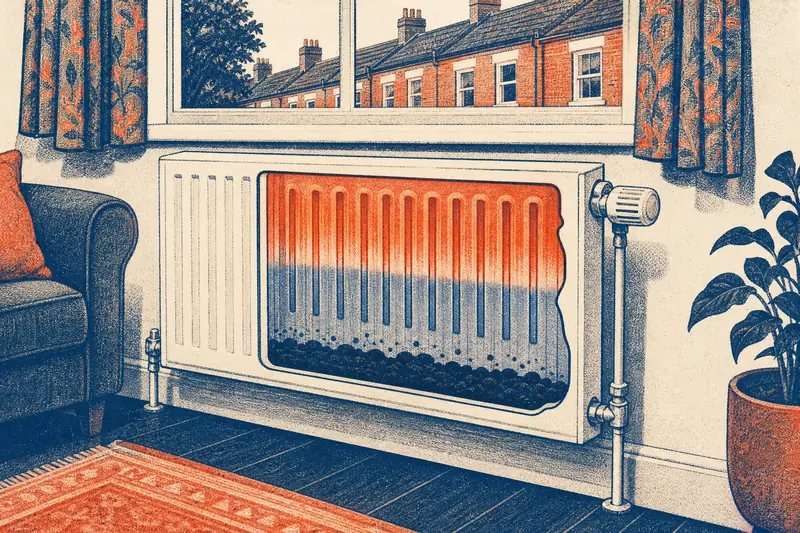
Go slowly; overfilling is the commonest reason pressure later reads too high. If the boiler showed a low-pressure fault, the user manual explains how to reset it once pressure is back. Bleeding radiators to clear air drops the pressure, so check the gauge again afterwards. The radiator signs that point to sludge rather than air are on powerflushing.
When is boiler pressure a job for an engineer?
Call a Gas Safe registered engineer when pressure keeps falling, stays high after bleeding, or the relief valve keeps discharging. Each of those points to a leak or a fault inside the system, and the work may mean opening the boiler. Gas safety regulation 3 requires anyone doing gas work to be competent, and anyone doing it as a business to be a member of the HSE-approved class, the Gas Safe Register; never open the boiler casing yourself.
Check the engineer's card before work starts. The Gas Safe Register's ID card page says each card carries a photo, the business name and registration number, a seven-digit licence number and, on the back, the work categories the engineer is qualified for. "If they cannot show you a valid Gas Safe ID card, do not allow them to carry out work at your property."
A leak on the heating side is your pipework, not the water company's. Leaks on the mains side and who pays are on water leaks. In a rented home the boiler is part of the yearly landlord gas check, set out on landlord gas safety and water duties. How hard water affects the hot-water side of the same boiler is on the combi boilers page; boilers and hot water gathers the group.
Where these figures come from
Based on the Baxi 400 Combi 2 user guide (August 2023), Baxi's pressure FAQ and high-pressure guide, Worcester Bosch's Greenstar 8000+ user instructions (June 2024), its boiler pressure page and radiator bleeding FAQ, the Vaillant ecoTEC plus storage combi installation manual, the 1998 gas safety regulations (regulation 3) and the Gas Safe Register's ID card page, read in October 2026. Left out: engineer call-out prices, fault codes for other makes, and any step inside the boiler casing, which is gas work.
Further questions
What does the green section on the gauge mean?
It marks the maker's normal range. Baxi says "the needle should stay in the green section", and Worcester Bosch tells you to stop filling when the indicator reaches the middle of the green bar, between 1 and 1.5 bar. Red usually means low; Worcester says a reading "dropped into the red" needs topping up.
Why does the pressure rise when the heating comes on?
Water expands as it heats, so the gauge climbs from its cold reading. Baxi says the needle rises when heating but "should not go higher than about 2.5 bar". That is why makers ask you to read and set the cold figure.
Is it safe to leave the filling loop connected?
Baxi's user guide says to disconnect the filling pipe after topping up, and its high-pressure guide lists a filling loop that is not fully closed as a cause of rising pressure. Close both taps fully whatever the design.
Will low pressure stop hot water as well as heating?
On a combi, yes: below about 0.5 bar Baxi and Vaillant boilers switch off and show a fault, and that stops hot water too. Topping up to the cold target and resetting per the user manual usually brings it back.
How often is it normal to top up?
The makers give no fixed number, but both Baxi and Worcester Bosch treat regular re-pressurising as a sign of a leak or fault. A top-up after bleeding radiators is expected; repeated top-ups without bleeding are not.
Can a tenant top up the boiler pressure?
The topping-up steps sit in the user manual, so check the tenancy and ask the landlord. Repeated pressure loss should be reported, since the landlord must keep heating and hot water installations in repair under the 1985 Landlord and Tenant Act, section 11.
Next pages
Back to the Chalk & Cistern front page