Lead Water Pipes: Check, Test, Replace
In short
Lead water pipes are likely only in homes built before about 1970; the legal limit at the tap is 10 µg/l, and Portsmouth Water tests for lead free and swaps its own section free once you replace yours.
Chalk & Cistern notes · checked and updated
Shop links on this page: Chalk & Cistern is owned by the same people as SoftPro Water Systems and Quality Water Treatment, the two US water-treatment shops linked on this page. They appear only as US reference models, and what a shop says about its products is reported as its claim. How shop links work
On this page
In brief
- The legal limit for lead at a consumer's tap is 10 µg/l (Schedule 1 of the 2016 water quality regulations).
- The Drinking Water Inspectorate says a home built before 1970 may have lead pipes; one built after is unlikely to.
- Portsmouth Water tests a supply for lead free of charge and replaces its own section of lead service pipe free once you replace yours.
- Its 2026 leaflet counts 5 lead failures in 5 years, all at customers' taps.
- After water has stood overnight, a washing-up bowl run off the kitchen tap normally clears the pipe (DWI).
- Of the two shops' drinking-water units, only one, the Waterdrop G3P600, holds a lead-reduction certificate (IAPMO R&T, NSF/ANSI 58, file WC-13976).
Does your house have lead water pipes?
Your house may have lead water pipes if it was built before about 1970 and the pipework has not been replaced. The Drinking Water Inspectorate's lead page draws the line there: before 1970 a home "may have lead pipes", after 1970 it is "unlikely" to. Portsmouth Water's own leaflet adds that lead pipes were phased out during the 1960s and, in its words, "officially became illegal in 1969".
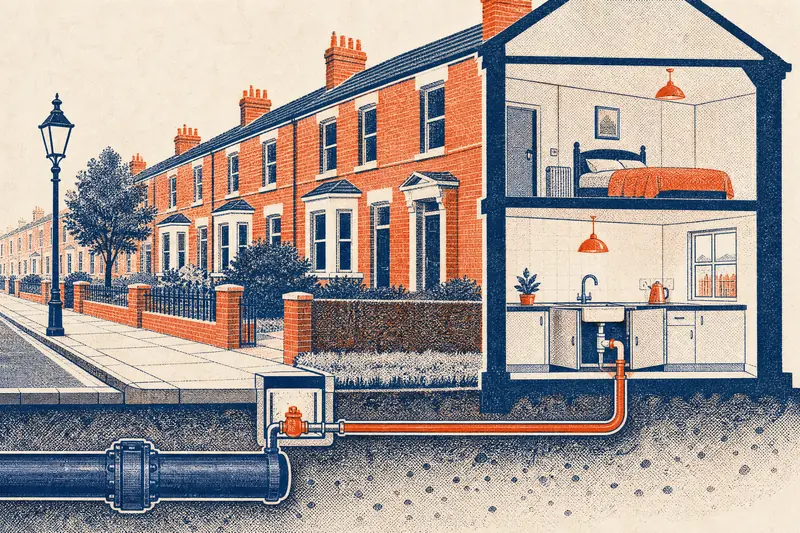
That puts a lot of Southsea, Fareham and Gosport in the frame. Victorian and Edwardian terraces were built long before the change, and some were never re-plumbed. The pipe most often left is the underground one between the outside stop tap and the kitchen, because it is out of sight.
The water itself starts clean. Portsmouth Water's lead pipes leaflet (2026) says water leaving its treatment works "does not contain lead". Lead gets in when water stands in an old lead pipe, for example overnight.
Lead in numbers
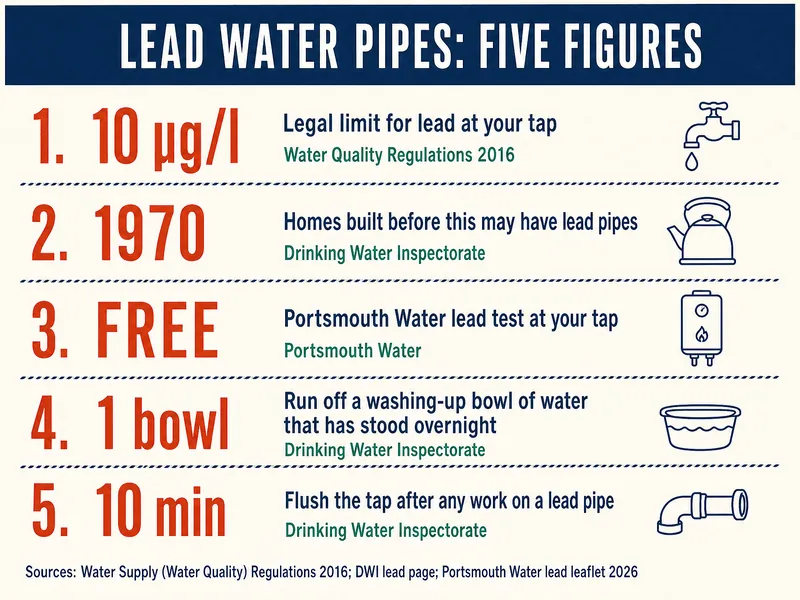
- 10 µg/llegal limit for lead at the tapWater Quality Regulations 2016, Sch 1
- 1970homes built before this may have lead pipesDrinking Water Inspectorate
- 5lead failures in 5 years, all at customers' tapsPortsmouth Water lead leaflet, 2026
- 4.9 µg/lhighest lead result in Farlington South (Southsea), 2025Portsmouth Water zone summary ZFA4
How do you tell a lead pipe?
Find the internal stop tap where the water comes in, usually under the kitchen sink, and look at the pipe just before it. The DWI describes unpainted lead as "dull grey", often with "a swollen joint next to the tap". The metal is soft: scrape it gently with a coin and you see shiny, silver-coloured metal underneath. Wear disposable gloves and avoid breathing any dust.
| Material | What it looks like | Scratch or feel |
|---|---|---|
| Lead | Dull grey, often a swollen joint near the stop tap | Soft; a coin shows shiny silver metal |
| Copper | Bright, dull brown when aged | Hard |
| Iron | Dark, may be rusty | Very hard |
| Plastic | Typically blue; older plastic may be grey or black | Flexible, not metal |
Painted pipes hide the colour, so the scrape test matters. Lead can also lurk where you cannot see it: under a floor or in the garden. Portsmouth Water's checklist adds a third pointer to the two above: a house built before 1970 "and the pipework has not been replaced".
Two other sources of lead are worth knowing. The DWI notes that lead solder is still allowed on closed central heating circuits, and mistakes happen when it is used on drinking-water pipes. Older brass fittings can also give off lead.
Who pays to replace lead pipes?
You pay for the pipe on your side of the boundary, and Portsmouth Water pays for its side. The company's leaflet says pipes "under the road or pavements up to the boundary" are usually its responsibility, while the pipe from the boundary "up to and including the internal plumbing" is normally the owner's. Ofwat's page on supply pipes sets out the same split: the company's communication pipe runs to the boundary, your supply pipe runs from there to the first stop tap indoors.
The useful part is the swap. If you replace your lead pipe "using an approved contractor", Portsmouth Water says you can ask it to replace its part "between the water main in the street and the stop valve", and "We do this free of charge". The DWI goes further: water companies are "legally required" to replace a lead communication pipe that risks adding lead to the supply, so tell the company when you arrange the work.
Portsmouth Water also replaces any lead service pipes it finds when renewing mains in the road. Its leaks, pressure and pipes page carries one warning for the job itself: make sure removing lead pipes "does not reduce electrical safety by removing earthing". For a plumber trained in the water fittings rules, the leaflet points to WaterSafe; the pipes and leaks hub covers the wider ownership question, and who is responsible for a water leak covers the money the company offers when a supply pipe leaks.
How do you get the water tested for lead?
Ask Portsmouth Water. Its leaflet says that if you think you may have lead pipes, it "will test your supply FREE of charge". Its water quality page adds a written report for anyone concerned about lead. The DWI says that if a company finds lead pipes or another source of lead, it "should provide you with written advice".
Published results give a sense of scale. Portsmouth Water's 2025 summary for Farlington South, the zone that covers Southsea, shows a lead mean of 1.9 µg/l and a highest single result of 4.9 µg/l, under the 10 µg/l limit. A zone figure is not your tap, though: an old lead pipe in one house can read higher than the street average.
Hard water helps a little. Both the DWI and Portsmouth Water say scale forming inside pipes reduces how much lead dissolves, and the company adds phosphate to most of its water for the same reason. The figures behind the hardness sit on how hard Portsmouth's water is.
Until a pipe is replaced, the DWI's short-term step is simple: before drinking or cooking, run off water that has stood in the pipe. "A washing up bowl full is normally enough", and a longer service pipe needs more. Feel for the water turning colder as fresh mains water arrives, then use the tap as normal. After any work on a lead pipe, flush the tap for at least 10 minutes.
Which filters are certified for lead?
Look for a certificate that names lead, not one that names only the materials or chlorine. In the US scheme, NSF/ANSI 58 covers reverse osmosis systems and NSF/ANSI 53 covers filters for contaminants with a health effect; NSF/ANSI 372 covers lead-free materials only, which is a different thing.
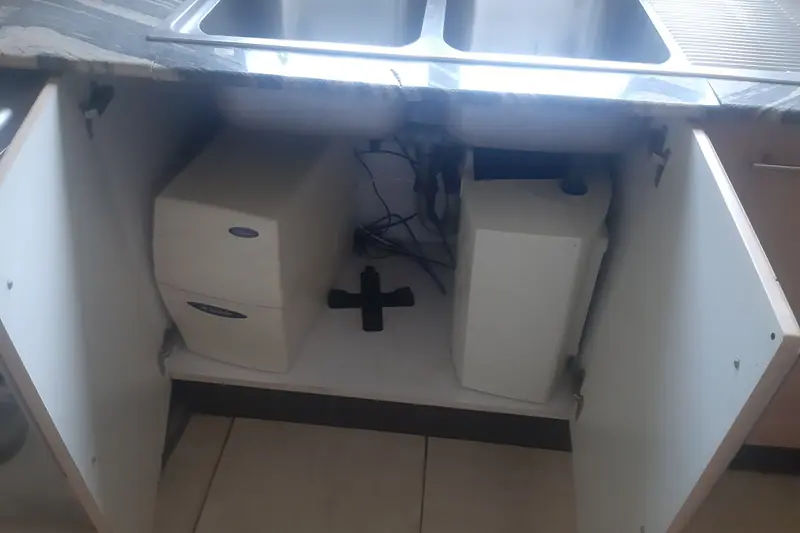
Of the two US shops linked on this site, one unit qualifies. The Waterdrop G3P600 under-sink reverse osmosis unit (SoftPro Water Systems, a US shop with the same owners as this site) is certified by IAPMO R&T to NSF/ANSI 58 for lead, TDS, fluoride, cadmium, barium and radium reduction (file WC-13976). It is a US reference model to compare, listed at $429 in the US shop (October 2026). Other Waterdrop models in the shops do not carry the lead claim on their certificates.
A filter treats the symptom, not the pipe. The DWI's advice is that lead pipes "should be replaced as soon as possible". It also cautions that reverse osmosis water is not generally seen as fit for everyday drinking and cooking unless minerals go back in, and that an RO unit sends 20 to 30% of incoming water to drain. In the UK any installation must meet the Water Supply (Water Fittings) Regulations 1999, and a unit that "incorporates reverse osmosis" needs notice to the water company first (regulation 5). Ask the installer to show the unit complies. Is reverse osmosis worth it and which water filters do what go further; the water hub links the rest.
Where these figures come from
This page draws on Schedule 1 of the 2016 water quality regulations, the Drinking Water Inspectorate's lead page (modified 2026), Portsmouth Water's lead pipes leaflet (uploaded October 2026), its leaks and pipes page and water quality page, its 2025 Farlington South zone summary, Ofwat's supply pipe page and IAPMO R&T's listing WC-13976, all read in October 2026. Left out: lab prices, replacement costs (none are published locally), health effects beyond the DWI's wording, and any filter claim not on a certifier's listing.
Further questions
Does Portsmouth Water's treated water contain lead?
Portsmouth Water's 2026 leaflet says water leaving its treatment works "does not contain lead". Lead gets in from old lead pipes, lead solder or old brass fittings between the main and your tap. That is why a test at your own kitchen tap tells you more than a zone average.
How often does Portsmouth Water find lead over the limit?
Its 2026 leaflet counts five lead failures in the last five years, all at customers' taps. In 2025 no zone failed for lead; the highest single result in Farlington South was 4.9 µg/l against a 10 µg/l limit.
Does hard water make lead pipes safer?
It helps but does not solve the problem. The DWI says harder water "tends to form a protective scale" that can reduce lead levels, and Portsmouth Water adds phosphate to most of its water. Particles of lead can still break off old pipes now and then, so replacement remains the fix.
Should a house buyer ask about lead pipes?
The DWI suggests asking the surveyor to check the outside and internal pipes, "making special mention of lead". It notes that buyers increasingly fold the cost of removing lead pipes into price negotiations. The stop tap check above takes a minute on a viewing.
Does replacing a lead pipe affect the electrics?
It can. Portsmouth Water warns that taking out lead pipes must not reduce electrical safety "by removing earthing". Ask the plumber how the earthing will be kept before the old pipe comes out.
Can lead come from copper pipes?
Yes, indirectly. The DWI says lead solder is still allowed on closed heating circuits and is sometimes used on drinking-water pipes by mistake, which is illegal. Older brass fittings can also release some lead.
Does a landlord have to replace lead pipes?
No opened source sets a specific lead-pipe duty for landlords. The 1985 Landlord and Tenant Act repairing duty covers installations for the supply of water, set out on landlord gas safety and water duties, and a free Portsmouth Water test is a sensible first step.
Next pages