Section · 4 pages
Boilers and Hot Water
In short
Boilers and hot water in Portsmouth run on 263 to 310 mg/l water, so scale control, a heating pressure of about 1 to 1.5 bar cold and a clean, inhibited circuit matter more than usual.
Chalk & Cistern notes · checked and updated
In brief
- Approved Document L treats water over 200 ppm as hard; every Portsmouth Water zone averages 263 to 310 mg/l (zone table, 2026).
- Most makers want heating pressure at about 1 to 1.5 bar cold; Baxi's safety valve operates above 3 bar.
- Before a new boiler goes in, Approved Document L says the circuits should be cleaned, flushed and dosed with inhibitor, and commissioned to BS 7593.
- An unvented cylinder needs two separate safety devices on top of its thermostat, and a tundish within 600 mm of the valve (Approved Document G).
- Bath hot water in new homes is limited to 48 °C under requirement G3(4).
- Gas work is limited to engineers on the Gas Safe Register (regulation 3 of the 1998 gas safety rules).
What does hard water do to boilers?
Hard water leaves limescale wherever it is heated, and in a combi that means the plate heat exchanger on the hot-water side. Approved Document L, paragraph 8.8, says that in hard water areas the feed to water heaters and "the hot water circuit of combination boilers" should be treated to reduce limescale. It defines hard water as over 200 ppm as calcium carbonate, a line every Portsmouth Water zone clears.
The makers word their thresholds differently. Worcester Bosch's Greenstar 4000 manual says that over 200 ppm temporary hardness a scale prevention device "may need" considering; Vaillant says softening "may make sense" above 15 °dH (267 ppm). For the radiator side, Baxi and Worcester Bosch ask that filling water bypass any salt softener.
Why does boiler pressure drop or climb?
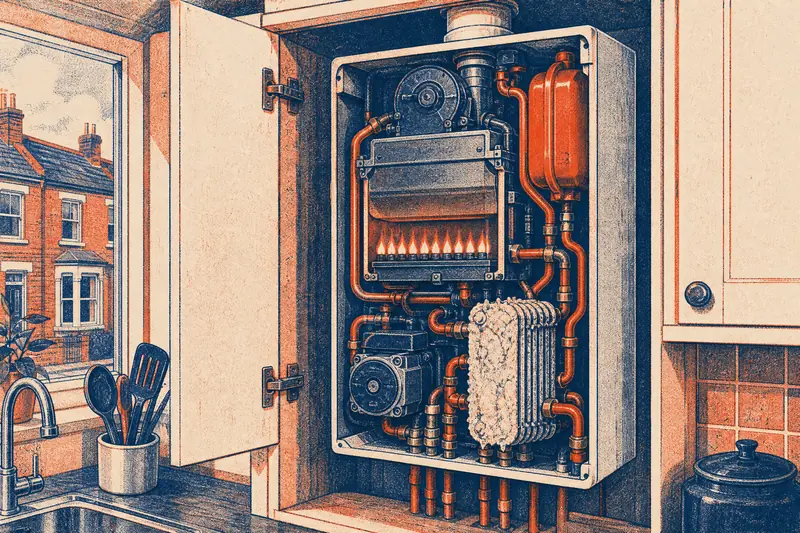
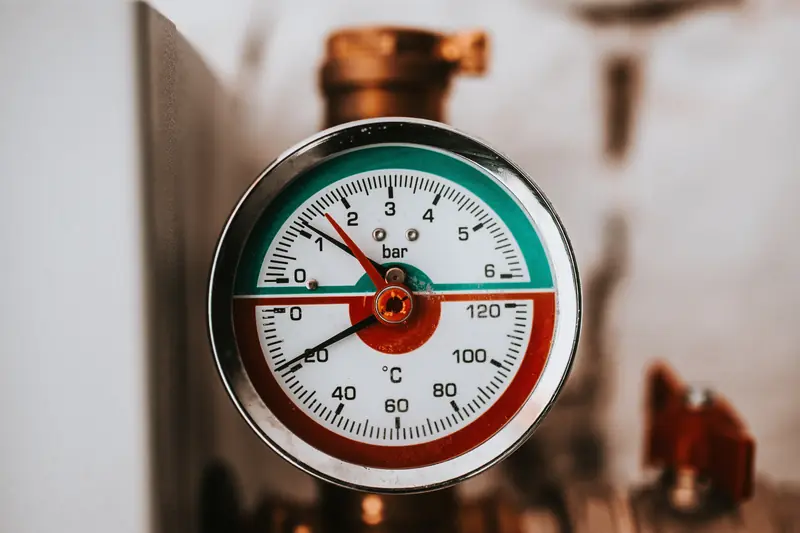
The gauge falls when water escapes the sealed circuit and rises when it is overfilled. Worcester Bosch's radiator bleeding FAQ notes that bleeding loses pressure, and both Worcester and Baxi say that needing to re-pressurise again and again indicates a leak. Baxi's high-pressure guide blames overfilling and a filling loop left open.
Most makers ask for about 1 to 1.5 bar cold, though some quote 1 to 2 bar, so your manual decides. Topping up via the filling loop is a user-manual job; anything inside the casing is not.
When does a heating system need cleaning?
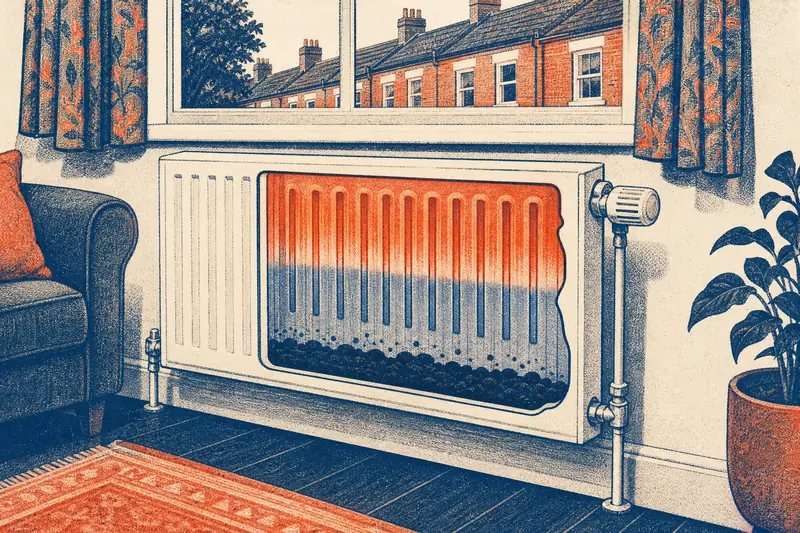
A heating system needs cleaning before a new boiler goes in, and when sludge signs appear. Approved Document L wants every heating and primary hot-water circuit cleaned and flushed before a new heat source is fitted, then dosed with inhibitor and set up to BS 7593.
Baxi's sludge FAQ lists the signs: radiators hot at the top but cold at the bottom, frequent bleeding, and a gurgling system. Fernox's summary of BS 7593:2019 names powerflushing, mains pressure and gravity cleaning as recognised methods, and Sentinel says a powerflush "can take several hours".
What rules cover hot water cylinders?
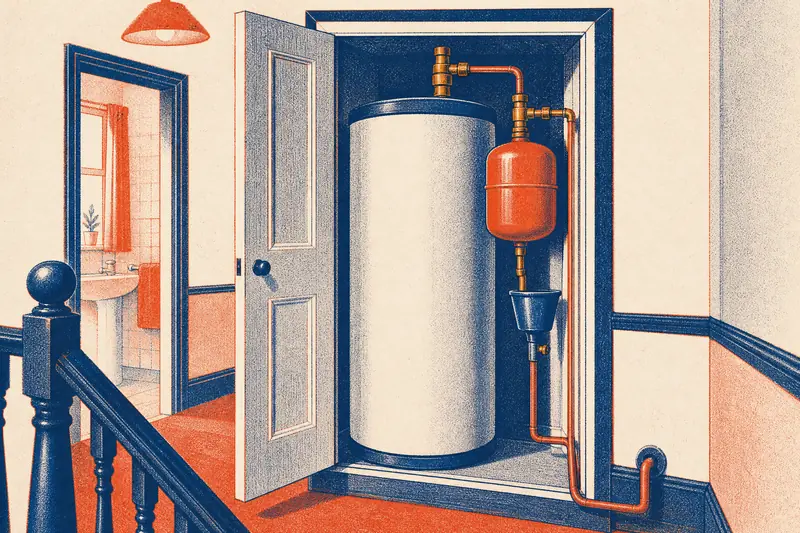
Unvented cylinders fall under Part G3 of the Building Regulations. Approved Document G says fitting one is notifiable building work unless the installer belongs to a competent person scheme, that the system needs a minimum of two safety devices that work apart from the thermostat, and that stored water must never pass 100 °C.
The discharge pipework has its own figures: no more than 600 mm of pipe from the valve to a visible tundish, then at least 300 mm of vertical pipe and a continuous fall of at least 1 in 200. Worcester Bosch's cylinder manual asks for the cylinder to be serviced every year, and the HSE names storing hot water at 60 °C as a legionella control.
Boilers and hot water by the numbers
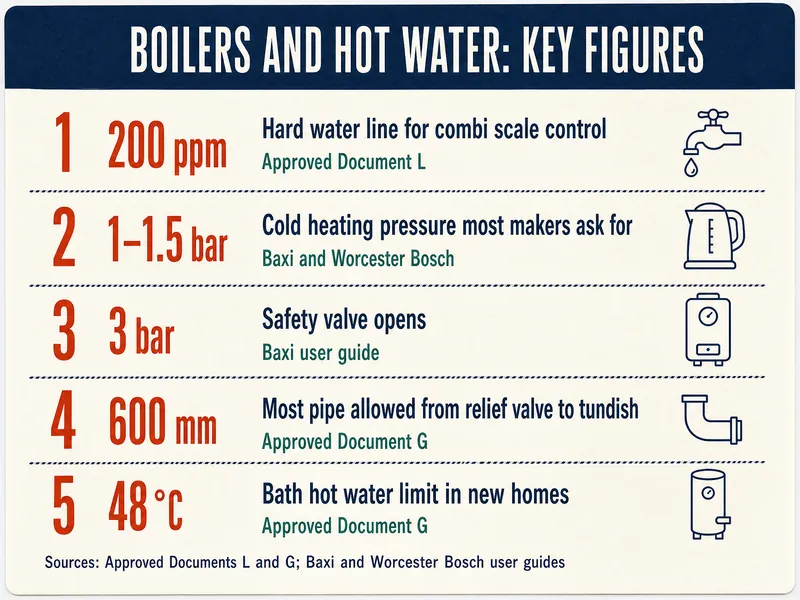
- 200 ppmwhere Approved Document L starts calling water hardADL Volume 1
- 92%seasonal efficiency floor for gas boilers (ErP)ADL Volume 1
- 3 barBaxi safety valve operates above thisBaxi 400 Combi 2 user guide
- 48 °Cbath hot water limit in new homesApproved Document G, G3(4)
| Topic | Rule or figure | Document |
|---|---|---|
| Combi scale control | Hot side treated where hardness tops 200 ppm | ADL paragraph 8.8 |
| New gas boiler | 92% or better on the ErP measure | ADL tables for new and existing homes |
| Heating pressure | About 1 to 1.5 bar cold; safety valve above 3 bar | Baxi 400 Combi 2 user guide (2023) |
| System cleaning | Clean, flush, add inhibitor, follow BS 7593 | Approved Document L, para 8.8 |
| Unvented cylinder | Two safety devices; tundish within 600 mm | Approved Document G, paras 3.17 and 3.54 |
| Landlord gas check | Every 12 months; record kept 2 years | Gas Safety (Installation and Use) Regulations 1998, reg 36 |
Landlords carry extra duties on the same equipment: a gas safety check no more than 12 months apart under regulation 36, and repairs to installations for space heating and heating water. Those sit on landlord gas safety and water duties. For the water feeding the boiler, start at Portsmouth water and limescale; for the whole site, the home page.
Where these figures come from
A summary of the four pages below it. Documents behind the figures: ADL Volume 1 in its 2021 form with the 2023 changes, ADG with its 2016 and 2024 changes, the Portsmouth Water hardness table for 2026, manuals and web advice from Baxi, Worcester Bosch and Vaillant, the Fernox note on BS 7593, Sentinel's flushing how-to, HSE legionella advice for landlords and regulations 3 and 36 of the gas safety rules; all were opened in October 2026. Not included: prices for boilers, cylinders or flushing, rankings of makes, and any step inside a gas appliance.
Further questions
Which page should you read first about a new boiler?
Start with combi boilers if the new boiler heats water on demand, since Portsmouth's hardness brings in the Approved Document L scale rule. If it feeds a cylinder, read the unvented cylinder page too.
Does hard water affect a system boiler with a cylinder?
Yes. Approved Document L applies the same scale-treatment wording to "the feed water to water heaters", which covers cylinders, and Worcester Bosch's cylinder Benchmark checklist asks whether a scale reducer is fitted in a hard water area.
Is BS 7593 a legal requirement?
Approved Document L says home heating systems "should" be prepared and commissioned to that standard. It is a British Standard code of practice that the official guidance points to, and Sentinel notes that many boiler makers now tie warranties to cleaning in line with it.
Who can work on a boiler?
Anything on a gas boiler beyond the user manual's steps, such as topping up pressure or bleeding radiators, is gas work. Regulation 3 of the 1998 gas safety regulations limits it to members of the class approved by the HSE, which is the Gas Safe Register.
What temperature should stored hot water be?
The HSE's landlord guidance names storing hot water at 60 °C as a legionella control. Approved Document G separately caps the hot water reaching a bath in new homes at 48 °C, for example with an in-line blending valve.
Why does Portsmouth count as a hard water area for building work?
Approved Document L defines hard water as over 200 ppm as calcium carbonate. Portsmouth Water's 2026 zone table runs from 263 to 310 mg/l, so every zone it supplies is over that line.