Private Water Supplies and Boreholes
In short
A private water supply is any borehole, spring or stream feeding a home instead of the mains; in Hampshire the district council regulates it under the Private Water Supplies (England) Regulations 2016.
Chalk & Cistern notes · checked and updated
Shop links on this page: Chalk & Cistern is owned by the same people as SoftPro Water Systems and Quality Water Treatment, the two US water-treatment shops linked on this page. They appear only as US reference models, and what a shop says about its products is reported as its claim. How shop links work

On this page
In brief
- About 1% of people in England and Wales use a private water supply, according to the Drinking Water Inspectorate.
- A council must risk-assess a supply to one house only if it serves a commercial or public activity, such as a let, or if the owner or occupier asks (regulation 6).
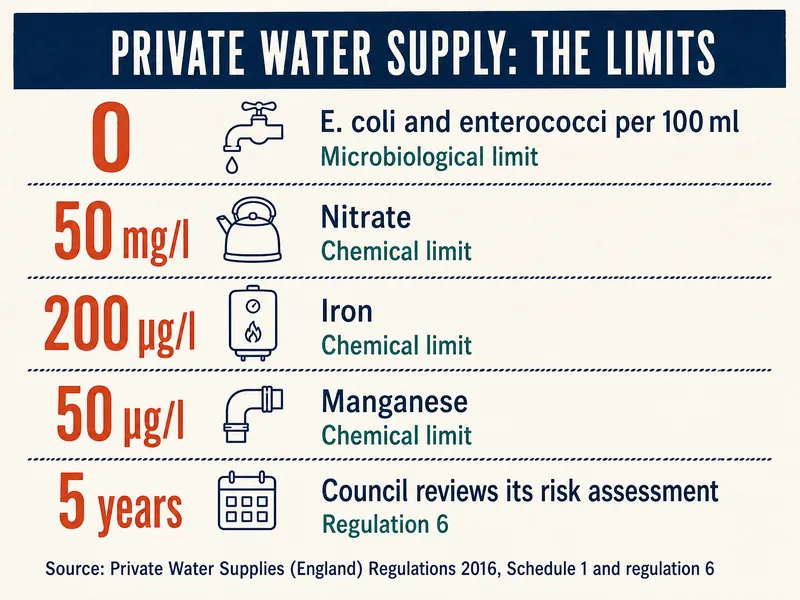
- The legal limits include 0 E. coli per 100 ml, 50 mg/l nitrate, 200 µg/l iron and 50 µg/l manganese.
- Winchester City Council lists about 160 registered supplies serving about 2,000 residents.
- The British Geological Survey notes the whole Hampshire Chalk outcrop became a Nitrate Vulnerable Zone in 2009.
- Treatment usually runs in stages: grit out first, then iron or hardness, then disinfection.
What counts as a private water supply?
A private water supply is any supply to a property that does not come from the mains or a licensed water supplier. The DWI lists boreholes, natural springs and watercourses as the usual sources, and puts users at about 1% of the population of England and Wales.
Around Portsmouth almost every home is on Portsmouth Water's mains. Private supplies sit further north, in the farms and hamlets of rural Hampshire, where a house, a farm or a cluster of cottages may draw from its own borehole. Winchester City Council's water quality page counts about 160 registered private supplies serving roughly 2,000 residents in its district.
The rock is the same chalk that feeds the public supply. Portsmouth Water says about 85% of the water it supplies is groundwater from boreholes and springs. A private borehole taps that aquifer without the treatment works in between, so the household takes on the job a water company would otherwise do.
Private supplies in numbers
- 1%of people in England and Wales use a private supplyDrinking Water Inspectorate
- 160registered private supplies in the Winchester districtWinchester City Council
- 5 yearscouncil review cycle for a supply's risk assessmentPrivate Water Supplies (England) Regulations 2016, reg 6
- 50 mg/llegal limit for nitratePrivate Water Supplies (England) Regulations 2016, Sch 1
What does the council have to do?
The council is the regulator, and its duties depend on who the supply serves. Under regulation 6 a local authority must risk-assess every private supply in its area and review that assessment every 5 years. For a supply to a single dwelling, the duty applies only where the supply is "part of a commercial or public activity"; otherwise the council must carry out an assessment "if requested to do so by the owner or occupier".
Monitoring follows the same pattern. Regulation 10 says a council may sample a single-dwelling supply and must do so if the owner or occupier asks. Larger supplies, those of 10 cubic metres a day or more, or any supply used in a commercial or public activity, fall under the stricter regulation 9 regime.
In practice, Winchester City Council says supplies serving up to 50 people for purely domestic use "need only be sampled once every 5 years", while holiday lets, tenanted properties and food businesses "must be sampled at least once a year". A supply to one private house has "no requirement to routinely sample". Councils charge for sampling: Winchester says it charges a fee, and East Hampshire District Council says the cost "is met by the person responsible for the supply". A landlord with a borehole-fed cottage is running a commercial activity, so the annual regime applies; landlord gas safety and water duties covers the rest of a landlord's list.

What should a borehole be tested for?
Start with the parameters the law makes councils check on small supplies. Regulation 10 lists conductivity, enterococci, E. coli, hydrogen ion (pH) and turbidity, plus anything the risk assessment flags, at least every 5 years. On chalk, add nitrate, and add iron and manganese if the water stains or tastes metallic.
| Parameter | Limit | Why it matters on a borehole |
|---|---|---|
| E. coli | 0 per 100 ml | Shows faecal contamination |
| Enterococci | 0 per 100 ml | A second faecal indicator |
| Nitrate | 50 mg/l | Farmland run-off into chalk |
| Iron | 200 µg/l | Colour and metallic taste |
| Manganese | 50 µg/l | Colour and metallic taste |
| Turbidity | 4 NTU | Cloudiness that weakens disinfection |
| pH (indicator) | 6.5 to 9.5 | An indicator value, not a health limit |
The figures come from Schedule 1 of the 2016 private supplies regulations. Ask the council first: the DWI calls councils the regulators and the "first point of contact for testing".
Turbidity deserves attention after heavy rain. The DWI's treatment guide for private supplies says groundwater "generally shows low to very low turbidity", but a change after heavy rain "may indicate rapid recharge bringing in contaminants from the surface". It names chalk sediment as one cause of cloudiness.
Is nitrate a problem in chalk boreholes?
It can be. The British Geological Survey's 2009 study of the Hampshire Chalk says human impact "is most plainly visible in the distributions of nitrate", found one source above the drinking-water limit, and notes that the whole Hampshire Chalk outcrop was designated a Nitrate Vulnerable Zone in 2009. Its study area ran from Basingstoke to Cadnam, so treat it as a guide to the rock, not to a particular well.
Units trip people up. The BGS reports nitrate "as N", where the limit is 11.3 mg/l; the regulations use 50 mg/l as nitrate, which the BGS treats as the same limit. Check which unit a lab report uses before comparing.
Portsmouth Water's figures show how close chalk water can run. Its 2025 zone summaries give nitrate means of 24.6 to 38.4 mg/l and a highest single result of 49.2 mg/l in the Lovedean zone, and that is after the company's blending; its water quality page says parts of its area need blending "to ensure that all our supplies are within the limits". The DWI's nitrate page says the 50 mg/l standard guards against methaemoglobinaemia, and that the last recorded UK case, in the 1950s, "was associated with the use of a shallow private well".
How is borehole water treated?
Treatment works in stages, and the order matters: particles out first, then minerals, then disinfection. The DWI notes that turbidity and colour cut the efficiency of UV disinfection and chlorination, which is why the clean-up comes before the lamp.
Grit and sand. A spin-down filter uses centrifugal separation and a fine screen to stop grit before it reaches valves. The SoftPro spin-down sediment filter (SoftPro Water Systems, a US shop with the same owners as this site) is one US reference model, with a 60-mesh screen; it handles grit only.
Iron, manganese and smell. The SoftPro Iron Master (SoftPro Water Systems, a US shop with the same owners as this site) is an air-injection filter that the shop says removes iron, manganese and hydrogen sulphide, and handles "up to 30 ppm of iron"; those are the shop's own claims, not a certificate.
Hardness. Chalk water is hard: the BGS says chalk produces water where calcium "predominates". Well softeners such as the SoftPro ECO well softener (SoftPro Water Systems, a US shop with the same owners as this site) or the SoftPro Elite well softener at Quality Water Treatment (Quality Water Treatment, a US shop with the same owners as this site) are sized by pump flow in the US listings. Keep an unsoftened tap for drinking, as the DWI advises; water softeners and softener size explain why and how.
Disinfection. UV or another disinfection step goes last, on clear water.
All of these are US reference models to compare, not UK stock. Test first and treat what the results show. The Water Supply (Water Fittings) Regulations 1999 cover fittings carrying water from a water undertaker, so a borehole-only house sits largely outside them; where a house also has a mains connection, any treatment unit on it must comply, and a regenerating softener needs notice to the water company first. Water regulations for home plumbing sets out that list, which water filters do what compares filter types, and how hard Portsmouth's water is gives the mains figures for comparison.
Where these figures come from
Based on the Private Water Supplies (England) Regulations 2016 (regulations 6, 9 and 10 and Schedule 1), the 1999 water fittings rules, the DWI's private supplies, treatment guide and nitrate pages, Winchester City Council's water quality page (updated March 2026), East Hampshire District Council's page, the BGS report OR/09/052 on the Hampshire Chalk (2009) and Portsmouth Water's 2025 zone summaries, read in October 2026. Left out: laboratory and council fees (not published as figures), borehole drilling costs, and any removal claim beyond what a shop listing itself says.
Further questions
Does the lead limit apply to a private supply?
Yes. Schedule 1 of the 2016 private supplies regulations sets lead at 10 µg/l, the same figure as for mains water. Old lead pipe inside the house matters as much on a borehole as on the mains; lead water pipes covers how to spot one.
Can a council force a homeowner to test a single-house borehole?
For a house used only by its owner, the council's risk assessment and monitoring duties start when the owner or occupier asks. Once the supply serves a let, holiday cottage or business, it is a commercial activity and the council must assess it. Winchester samples those at least once a year.
Is spring water safer than borehole water?
The sources opened here do not rank them. The DWI notes that cloudiness changing after heavy rain can mean surface water is reaching the source quickly, which matters for any shallow source. Test results, not the type of source, settle it.
Why does nitrate matter for babies?
The DWI says the 50 mg/l limit is "a safeguard against methaemoglobinaemia". It also notes the last UK case was in the 1950s and linked to a shallow private well.
Who pays for council sampling?
The owner or person responsible. East Hampshire District Council says the cost "is met by the person responsible for the supply", and Winchester City Council says it charges a fee for taking a sample. Neither page opened here prints the amount.
Does a borehole house need a water softener?
Not by law. Chalk water is hard, and the DWI's treatment guide says a softener placed ahead of the boiler or hot-water tank is "a more economical method" of stopping limescale than treating every tap. It also advises an unsoftened outlet for drinking.
What does Portsmouth Water have to do with a private supply?
Nothing, unless the house also has a mains connection. Portsmouth Water does not regulate a borehole or its treatment; the council does. Where a mains connection exists, the fittings on it fall under the 1999 water fittings rules.
Next pages