Is Reverse Osmosis Worth It?
In short
Reverse osmosis systems strip most dissolved minerals from drinking water, but the DWI says RO is rarely needed on mains water, sends 20–30% of the flow to drain, and must be notified to the water company.
Chalk & Cistern notes · checked and updated
Shop links on this page: Chalk & Cistern is owned by the same people as SoftPro Water Systems and Quality Water Treatment, the two US water-treatment shops linked on this page. They appear only as US reference models, and what a shop says about its products is reported as its claim. How shop links work
On this page
An under-sink reverse osmosis unit pushes water through a membrane fine enough to hold back most dissolved salts, then sends the concentrate to drain. It is the most thorough kind of point-of-use treatment and also the one the UK drinking-water regulator is coolest about. Chalk & Cistern sets the claims beside the certificates, the law and Portsmouth Water's own tap results.
In brief
- The DWI says RO should be considered "only for specialist domestic purposes", such as photographic processing or hydroponics, and is "not generally considered suitable" for drinking and cooking.
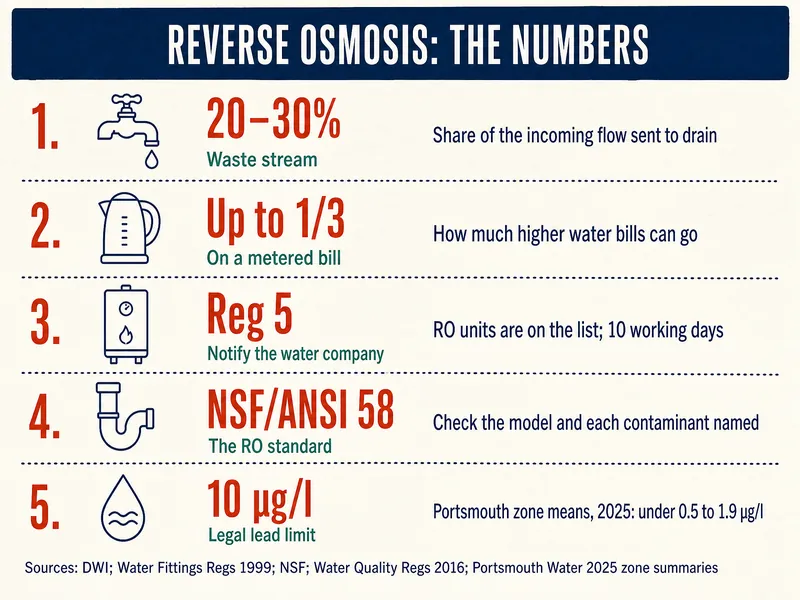
- RO produces a waste stream of 20–30% of the incoming flow, and on a metered supply can raise water bills by up to a third, the DWI says.
- A unit that incorporates reverse osmosis is item 4(e) on the notification table in regulation 5 of the Water Fittings Regulations 1999; the water company has 10 working days to respond.
- NSF/ANSI 58 is the standard for RO units, and NSF says certification "does not mean" a system reduces every contaminant.
- Portsmouth Water's 2025 zone results put average lead at taps between under 0.5 and 1.9 µg/l, against a legal limit of 10 µg/l.
- Of the two RO units the US shops list, only the Waterdrop G3P600 is certified for lead reduction (IAPMO R&T, file WC-13976).
What does reverse osmosis remove?
Reverse osmosis removes most dissolved substances from water, including hardness minerals, sodium, fluoride and many metals, by forcing water through a semi-permeable membrane under pressure. NSF's guide to treatment standards describes RO systems as using "reverse pressure" to push water through the membrane, reducing contaminants regulated by the US EPA and Health Canada.
The Waterdrop units described below pair the membrane with a carbon stage, which is what handles chlorine taste. What a given model actually reduces is whatever its certificate lists, and nothing more: NSF warns that certification to one of its standards does not cover "all possible contaminants", and that the numbers in the standards' names are not a ranking.
The water that comes out is low in minerals. The DWI notes that the World Health Organization recommends minerals "should be added back", which is why some units add a remineralising stage.
Is reverse osmosis worth it on Portsmouth water?
For most homes on Portsmouth Water's mains, reverse osmosis is hard to justify on health grounds: the DWI's position is that there is no need for extra treatment in the home "as a health protection measure". Portsmouth Water's 2025 zone summaries record no lead or nitrate failures at consumers' taps.
The local figures, from the company's 2025 zone summaries and the legal standards in Schedule 1 of the Water Supply (Water Quality) Regulations 2016:
| Substance | Legal limit at the tap | Range of zone averages, 2025 | Highest single result |
|---|---|---|---|
| Lead | 10 µg/l | under 0.5 to 1.9 µg/l | 4.9 µg/l (Farlington South) |
| Nitrate | 50 mg/l | 24.6 to 38.4 mg/l | 49.2 mg/l (Lovedean) |
| Fluoride | 1.5 mg/l | 0.080 to 0.385 mg/l | 0.471 mg/l (Worlds End) |
| Sodium | 200 mg/l | under 9.1 to 13.9 mg/l | 14.7 mg/l (Littleheath) |
| Free chlorine | WHO guideline 5 mg/l (cited by the DWI) | 0.39 to 0.54 mg/l | 0.79 mg/l (Walderton) |
There are cases where RO earns its place. A home with lead pipework is one: the DWI says homes built before 1970 may have lead pipes, and replacing them is the lasting fix (see lead water pipes), with a lead-certified RO unit as an interim measure. Hardness is another: RO takes out the 263–310 mg/l of calcium carbonate that makes Portsmouth's kettles fur, which matters more to someone running a coffee machine or an aquarium than to their health. No Portsmouth Water supply is artificially fluoridated.
What should an RO certificate say?
An RO certificate should name the exact model, the standard (NSF/ANSI 58 for reverse osmosis), the certifying body and each contaminant the unit is certified to reduce. Read the contaminant list, not the badge: two models from the same family can carry the same file number and different claims.
The Waterdrop units are a clear example. IAPMO R&T certifies the G3P600 to NSF/ANSI 58 (file WC-13976) for lead, TDS, fluoride, cadmium, barium and radium, while the G3-W under the same file is certified for TDS, fluoride, cadmium, hexavalent chromium and selenium, but not lead. The carbon stage in both holds NSF/ANSI 53 for PFOA and PFOS, and NSF/ANSI 42 for chlorine taste and odour.
A US or Canadian certificate is not the same as UK fittings approval. The DWI says products must meet regulation 4 of the Water Fittings Regulations and suppliers must be able to show it, and Water Regs UK adds that certification in isolation cannot prove compliance, since it depends on how and where the unit is fitted.
Do you have to tell the water company about RO?
Yes. You have to tell the water company before fitting an RO unit: the DWI says "by law consumers must give notice", and the legal basis is item 4(e) of the notification table, "a unit which incorporates reverse osmosis". Work must not start until the company consents, and it has 10 working days to refuse or set conditions before consent is deemed given.
Unlike some items on the list, RO has no approved-contractor exemption from giving notice: regulation 5(2) excuses only items 2, 4(b) and 4(g). Fitting without notice is an offence carrying a fine of up to level 3 (regulation 7). The water regulations page has the full list and how to give notice.
Ask the installer how the drain line connects and what backflow protection is fitted. The DWI's taste page warns that wrongly fitted treatment devices and filters can let water with added salt flow back into the supply.
How much water does reverse osmosis waste?
Reverse osmosis wastes a lot of water by household standards: the DWI puts the waste stream at 20–30% of the incoming flow and says RO on a metered supply can raise water bills "by up to one third". Some sellers advertise far better ratios; read those as the maker's claim, since the regulator's figure is the one with no product to sell.
The cost lands twice in this area. Metering is now compulsory in Portsmouth Water's area, and sewerage is normally charged on 92.5% of metered water, so the drain water from an RO unit is paid for on the way in and on the way out.
If chlorine taste is the only complaint, the DWI suggests a cheaper fix: a covered glass jug of tap water kept in the fridge. Portsmouth Water says not to keep it more than 24 hours. The water filters page compares the other options.
RO soundings
- 20–30%Share of the incoming flow sent to drain by RODWI
- 1/3Most an RO unit can add to a metered water billDWI
- 4(e)Notification item for units incorporating ROWater Fittings Regs 1999, reg 5
- 10 µg/lLead standard for tap water in England2016 drinking water regulations, Schedule 1
Which RO units do the US shops list?
Both US shops sell a tankless under-sink RO unit from Waterdrop, each with its own drinking tap. The Waterdrop G3P600 at SoftPro (SoftPro Water Systems, a US shop with the same owners as this site) is certified by IAPMO R&T to NSF/ANSI 58 for lead, TDS, fluoride, cadmium, barium and radium reduction (file WC-13976). The Waterdrop G3-W at Quality Water Treatment (Quality Water Treatment, a US shop with the same owners as this site) is certified to the same standard for TDS, fluoride, cadmium, hexavalent chromium and selenium, but not lead; its listing names NSF as the certifier, while the certificate is held at IAPMO R&T.
Both appear here as US reference models for comparing stages and certificates, not as products for a UK home. Any RO unit fitted in England must meet the Water Fittings Regulations and be notified to the water company first, so a UK reader should look for a unit the installer can show complies.
Where these figures come from
Sources: the DWI's pages on domestic filters and softeners (modified February 2026), lead (2026) and taste and odour, NSF's guide to water treatment standards, regulations 4, 5 and 7 of the 1999 fittings rules, Schedule 1 of the 2016 drinking water quality rules, Water Regs UK's note on compliant fittings, Portsmouth Water's 2025 zone summaries, 2026 hardness table and metering pages, IAPMO R&T certificate records for file WC-13976 (checked October 2026, expiry November 2027) and both shops' RO listings; everything was read in October 2026. Not included: the shops' and Waterdrop's water-saving ratios, PFAS and health claims beyond the certificate wording, and installation prices.
Further questions
Does an RO unit need its own tap?
Most under-sink units deliver through a separate small tap beside the main mixer, which keeps RO water apart from the hot and cold supply. Some three-way kitchen taps combine both; either way, the unit itself is what must be notified.
Can reverse osmosis water be used for baby feeds?
The NHS formula guide says to use freshly boiled drinking water from the tap and not artificially softened water. It says nothing specific about RO water, so ask a health visitor before using it for feeds.
How often do RO filters and membranes need changing?
Follow the maker's schedule for each stage. The DWI warns that cartridges not changed as the maker says stop working and "may leach other chemicals or bacteria".
Does RO take out chlorine?
The membrane is not what deals with chlorine; the carbon stages are. The Waterdrop units above hold NSF/ANSI 42 certification for chlorine taste and odour through their carbon filter.
Does reverse osmosis remove limescale?
Yes, for the water it treats: hardness minerals are among the dissolved salts the membrane holds back. It only treats one tap, though, so it does nothing for showers, boilers or appliances (see scale reducers).
Read on