Water Meters: Reading, Bills and Leaks
In short
Water meters are now compulsory across the Portsmouth Water area; you read the black digits in cubic metres, and sewerage is normally billed on 92.5% of what the meter records.
Chalk & Cistern notes · checked and updated
On this page
In brief
- Metering is compulsory in the Portsmouth Water area: its own FAQ answers "Do I have to have a meter?" with "Yes."
- For the first 12 months on a meter, Portsmouth Water's Lowest Bill Promise charges whichever is lower, metered or unmetered.
- The wastewater company normally bills sewerage on 92.5% of the water the meter records.
- Read only the black digits, which count cubic metres (1 cubic metre is 1,000 litres); ignore the red figures.
- Around 38% of leaks are on customers' own pipes and plumbing, according to Portsmouth Water's Find it. Fix it. campaign.
- A metered household that repairs a supply-pipe leak within 60 days may get a leak allowance, once in any five years.
Do you have to have a water meter?
Yes: in the Portsmouth Water area a meter is no longer optional. The company's moving to metering page answers the question with a single word, "Yes", and its general FAQs add that if you move into a home that already has a meter, you cannot have it taken out.
The first year comes with a cushion, the Lowest Bill Promise. For the first 12 months with a meter, Portsmouth Water says it will automatically charge whichever is lower: the bill with the meter or the bill you would have paid without one. After that year, you pay for what the meter records. Metered bills come every six months.
Portsmouth Water names Portsmouth, Gosport, Fareham and Havant among the towns it supplies, so the same metering rules reach well beyond the city. Sewerage is a separate service from a separate company (Southern Water in this area), which is why the bill has two parts.
How do you read a water meter?
You read the black digits only. Portsmouth Water's metering page says the black numbers record consumption in cubic metres and the red figures should be ignored. One cubic metre is 1,000 litres, so a reading that rises from 0412 to 0419 over a week means 7,000 litres went through the meter.
Write down the black digits and the date, then do the same a week or a month later. The difference is what you used in that period. Comparing that with the figures on your last bill shows whether the company's reading and yours roughly agree.
Readings only mean something if nothing interferes with the meter. Regulation 3 of the 1999 water fittings rules says no fitting may be installed or used in a way that causes or is likely to cause "the erroneous measurement of water". A bypass round the meter, or a branch taken off before it, falls foul of that rule.
Where is the meter usually fitted?
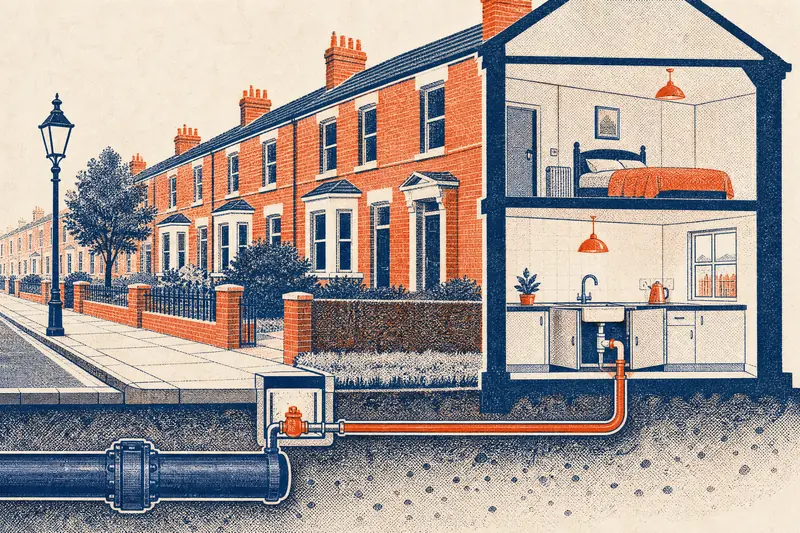
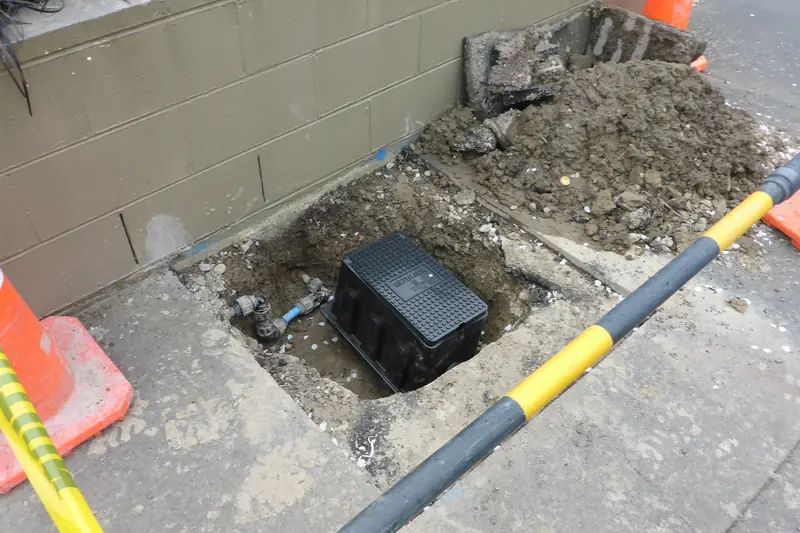
Most meters sit outside, in a box with the stop tap, usually in the pavement or the property's driveway, as Portsmouth Water describes it. Look for a small cast cover at or near the front boundary.
That box also marks a line of ownership. Ofwat's supply pipe guidance says the communication pipe runs from the main to the boundary, and where a company stop tap is fitted it normally marks the end of the company's pipework. From there to the first fitting or stop tap inside the house is the supply pipe, and that is yours to maintain, including "leak detection, repairs and replacement".
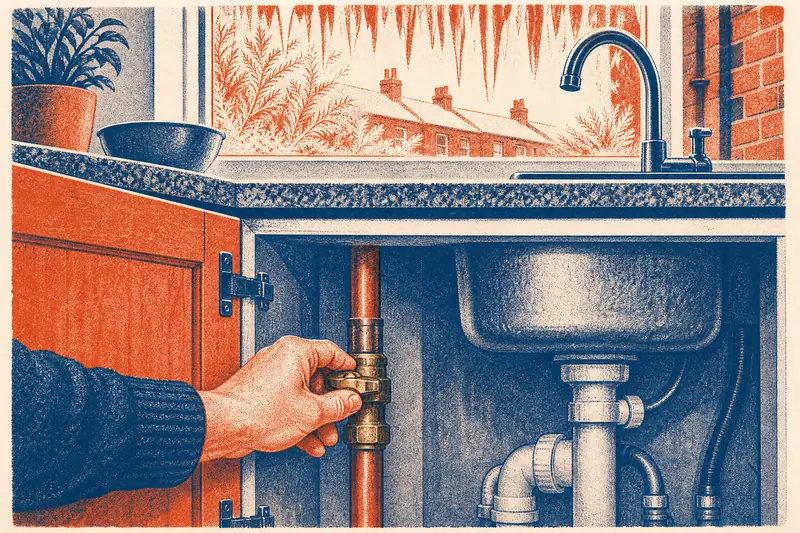
Inside, the house stop tap is usually under the kitchen sink. Knowing where both are saves time if a pipe ever bursts; burst and frozen pipes covers what to do first.
How is sewerage billed on a meter?
On a meter, the sewerage bill is normally worked out from 92.5% of the recorded water. Portsmouth Water passes the readings to the wastewater company, which, in the company's words, will "normally base their charges for wastewater on 92.5% of the consumption recorded by the meter".
So every cubic metre through the meter costs you twice: once for supply and, on 92.5% of it, once for sewerage. That makes leaks and wasteful fittings more expensive on a meter than on an unmetered bill.
| Item | What the source says | Source |
|---|---|---|
| Switching to a meter | First 12 months: charged the lower of metered or unmetered | Portsmouth Water, Lowest Bill Promise |
| Sewerage | Normally based on 92.5% of metered water | Portsmouth Water, metering FAQ |
| Reverse osmosis unit | Can raise a metered bill by up to one third | Drinking Water Inspectorate |
| Supply-pipe leak | Leak allowance possible if repaired within 60 days | Portsmouth Water, leaks page |
| Bill frequency | Every six months | Portsmouth Water, metering page |
Treatment kit can add to the bill too. The Drinking Water Inspectorate says a reverse osmosis unit produces a waste stream of 20–30% of the incoming flow and, on a metered supply, can increase bills by up to one third. The reverse osmosis page covers that trade-off, and water softeners also use water to regenerate.
Can a meter show a hidden leak?
Yes: Portsmouth Water says that if you have a meter, "that is often the best place to start" when looking for a hidden leak. Its Find it. Fix it. campaign adds that around 38% of leaks happen on customers' pipes and plumbing, not on the company's mains.
Chalk & Cistern does not print a step-by-step meter test, because no written procedure from Portsmouth Water could be opened; the company points to its own video on that page. The general idea is simple enough: a meter that keeps counting while every tap and appliance in the house is off suggests water is going somewhere.
If the leak turns out to be on the underground supply pipe, money is available. Portsmouth Water's leaks, pressure and pipes page lists:
- £100 towards a repair, or £200 towards replacing the whole supply pipe, if the work is done within 30 days of the leak being found (not for business, council or housing association premises);
- a leak allowance on metered bills when the supply-pipe leak is repaired within 60 days, limited to one allowance per property in five years;
- an allowance that covers at most the previous 12 months or two measured bills, whichever is longer, for external supply-pipe leaks only.
Tell Portsmouth Water before the repair starts; its page says that is a condition of the allowance, and every allowance is at the company's discretion. The water leaks page explains who owns which pipe in more detail.
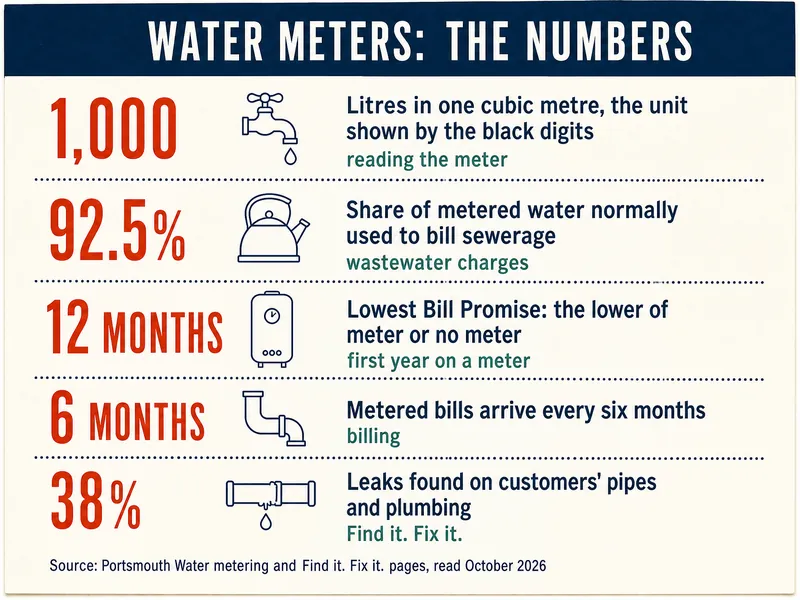
Metered water by the numbers
- 92.5%of metered water normally used to bill seweragePortsmouth Water
- 12 monthsLowest Bill Promise after a meter is fittedPortsmouth Water
- 38%of leaks on customers' pipes and plumbingPortsmouth Water
- 60 daysto repair a supply-pipe leak for a leak allowancePortsmouth Water
Does a meter change what fittings you can add?
Not directly, but several fittings that use a lot of water need advance notice to Portsmouth Water. Under regulation 5 of the Water Fittings Regulations that includes a bath of more than 230 litres, a pump drawing more than 12 litres a minute, a reverse osmosis unit and a water treatment unit that uses water for regeneration. The water regulations page lists the rest. On a meter, those same fittings show up on the bill.
Where these figures come from
This page draws on Portsmouth Water's moving to metering page, its FAQs, its leaks, pressure and pipes page and its Find it. Fix it. campaign page; Ofwat's supply pipe guidance; the 1999 water fittings rules (regulations 3 and 5); and the Drinking Water Inspectorate's filters and softeners page (2026). Each was opened and read during October 2026.
Omitted on purpose: metered tariffs and prices (they change each April and were not checked), Southern Water's own sewerage wording (its website could not be read), and a step-by-step meter leak test, because no written procedure from Portsmouth Water was available.
Further questions
Can you refuse a water meter in Portsmouth?
No. Portsmouth Water's metering page says a meter is now required in its area. The Lowest Bill Promise softens the first year by charging the lower of the two bills.
What do the red numbers on a water meter mean?
Portsmouth Water's metering page simply says to ignore them when you read the meter. The black digits are the ones that count, and they record cubic metres.
How many litres is one unit on a water meter?
One cubic metre, which is 1,000 litres. A bill priced "per cubic metre" is therefore priced per thousand litres of water.
Who pays if the meter box itself is damaged?
The meter shares its box with the stop tap, which Ofwat says normally marks the end of the company's pipework. Report damage to Portsmouth Water through its website and let the company decide whose repair it is.
Does a meter make a shared supply pipe harder?
It can. Ofwat says a supply pipe that serves several homes is the joint responsibility of all the owners it serves, so a leak on a shared length is shared too. Ask Portsmouth Water how a shared pipe is metered at your address.
Do outside taps count towards sewerage charges?
Everything through the meter is counted, and sewerage is normally billed on 92.5% of it. The percentage is applied to the whole reading, so garden water is not measured separately on a single meter.
Is a meter reading useful to a landlord?
Yes, as a dated record when one tenant leaves and the next moves in. The landlords page covers the repair duties for water and heating installations that sit alongside it.
More on pipes and bills