Scale Reducers and Salt-Free Conditioners
In short
Scale reducers limit limescale without taking hardness out of the water; on Portsmouth's 263–310 mg/l supply, Approved Document L expects some form of scale control on a combi's hot water or a water heater's feed.
Chalk & Cistern notes · checked and updated
Shop links on this page: Chalk & Cistern is owned by the same people as SoftPro Water Systems and Quality Water Treatment, the two US water-treatment shops linked on this page. They appear only as US reference models, and what a shop says about its products is reported as its claim. How shop links work
On this page
"Scale reducer" covers several quite different devices: a cartridge that doses polyphosphate, a magnet clamped to a pipe, an electronic coil, a tank of conditioning media. Some have a maker's blessing for boilers; one kind the DWI says plainly does not soften water. Chalk & Cistern sorts them out against the building guidance and boiler makers' own words.
In brief
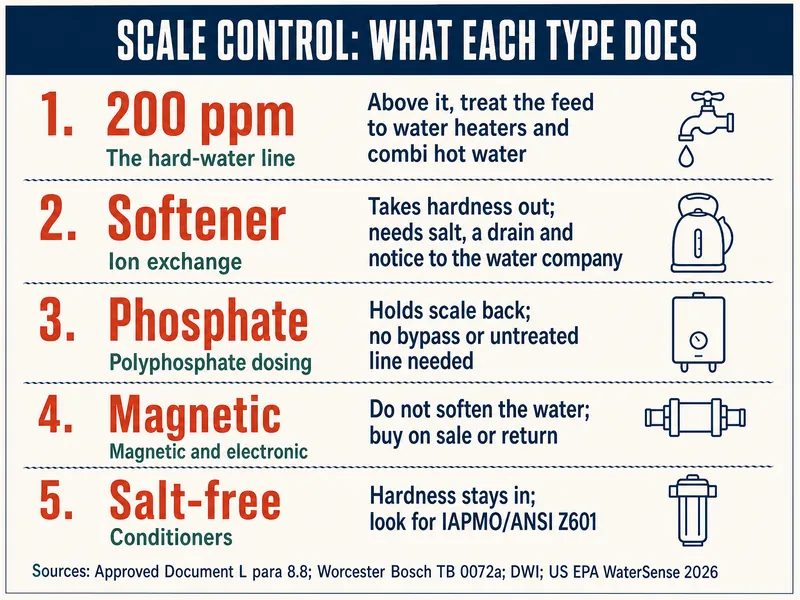
- Approved Document L, para 8.8, asks for limescale treatment of the water feeding water heaters and combi hot-water circuits wherever hardness passes 200 ppm as calcium carbonate.
- Every Portsmouth Water zone averaged between 263 and 310 mg/l in 2026, so the whole supply area sits over that 200 ppm line.
- Worcester Bosch's technical bulletin TB 0072a lists magnetic, electronic, electrolytic and polyphosphate inhibitors as suitable for its appliances.
- The DWI says magnetic and electronic devices "do not soften the water" and suggests buying on a sale-or-return basis.
- The US EPA says salt-free conditioners leave the hardness in and points buyers to the IAPMO/ANSI Z601 standard for scale reduction devices.
- Vaillant's ecoTEC plus manual puts its own threshold at 15 °dH (267 ppm), where softening or stabilising "may make sense".
What is a scale reducer?
A scale reducer is any device fitted to the water supply to cut the amount of limescale that forms, usually on the cold feed to a combi boiler, a water heater or the whole house. Unlike a salt softener, most types leave the calcium and magnesium in the water and aim to stop them settling as scale when the water is heated.
Building guidance and boiler paperwork use the term loosely. The Benchmark commissioning checklist in Worcester Bosch's Greenstar 4000 manual asks of combi installations whether the property is in a hard-water area "above 200ppm" and offers "Water scale reducer/softener" as the box to tick, so either route can satisfy the form.
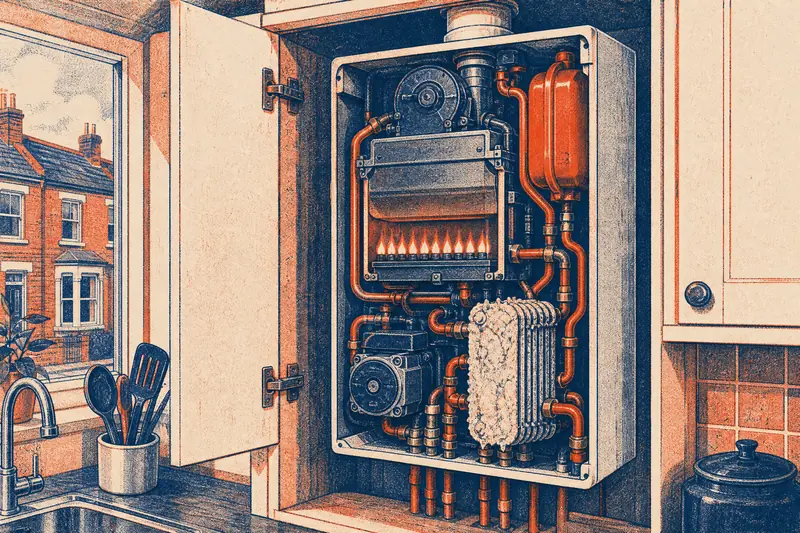
Where scale bites first on a combi is the plate heat exchanger that heats your hot taps. Vaillant's fault table lists "Scale in the secondary heat exchanger" as a cause, with descaling or replacement as the remedy; the limescale page explains why heat makes scale form.
Does a scale reducer soften water?
No, a scale reducer does not soften water in the sense the term is used for softeners: the hardness stays in. The DWI says it directly of magnetic and electronic devices: "These devices do not soften the water". The EPA describes salt-free conditioners as treating hardness "instead of removing the hardness ions".
That matters for two reasons. A water test after fitting one will show much the same hardness, so it cannot be used to check the device works. And because nothing is swapped for sodium, the drinking-water and baby-feed advice that applies to salt softeners does not arise in the same way.
The DWI's advice for magnetic and electronic types is to buy "only on a sale or return basis" and to ask the seller for data on how the device performs in a home, not in a laboratory.
When does building guidance expect scale control?
Building guidance expects scale control whenever a combi boiler or water heater is fitted in a hard-water area, which Approved Document L defines as total hardness "greater than 200ppm of CaCO3". The 2021 edition with 2023 amendments puts the rule at para 8.8; the 2026 edition repeats it at para 7.8(c) for work under the new standards.
Portsmouth Water's 2026 hardness table shows no zone below 263 mg/l, and the Portsmouth city zones, which include Southsea, at 277 to 282. In practice, a new combi anywhere in the supply area should come with some form of scale treatment on its hot-water side.
Makers phrase their own thresholds differently, and they should not be merged into one rule:
- Worcester Bosch: where temporary hardness exceeds 200 ppm, "consideration may need to be given to the fitting of a scale prevention device"; the terms for its hot-water heat exchanger cover say the mains must then be protected by a suitable device.
- Vaillant: above 15 °dH (267 ppm) it "may make sense" to soften or stabilise the water, and for hot water this "may be necessary".
- Baxi: the 600 Combi 2 manual has a hard-water section but gives no ppm figure; it asks for the heating circuit to be filled from a point upstream of any softener.
The combi boilers page goes into each maker's manual in more detail.
| Type | Takes hardness out? | Salt, drain or notice? | What the sources say |
|---|---|---|---|
| Polyphosphate dosing cartridge | No | No bypass or untreated line needed (Worcester) | Suitable with Worcester appliances (TB 0072a) |
| Magnetic or electronic unit | No | None | DWI: does not soften; buy on sale or return |
| Electrolytic unit | No | None | Listed as suitable by Worcester (TB 0072a) |
| Salt-free conditioner (media tank) | No | No regeneration on the shops' description | EPA: look for IAPMO/ANSI Z601 |
| Ion-exchange salt softener | Yes | Salt, drain, and notice under reg 5 | DWI: keep an unsoftened drinking tap |
Which kinds of scale reducer are there?
There are four broad kinds of scale reducer: polyphosphate dosers, magnetic units, electronic or electrolytic units, and salt-free conditioning tanks. Worcester Bosch's technical bulletin TB 0072a names the first three and says "All of these are suitable" with its appliances.
Polyphosphate units add a dose of phosphate to the water passing through them. Worcester notes they "must not be confused with water softeners" and need neither a bypass nor an untreated line to the heating.
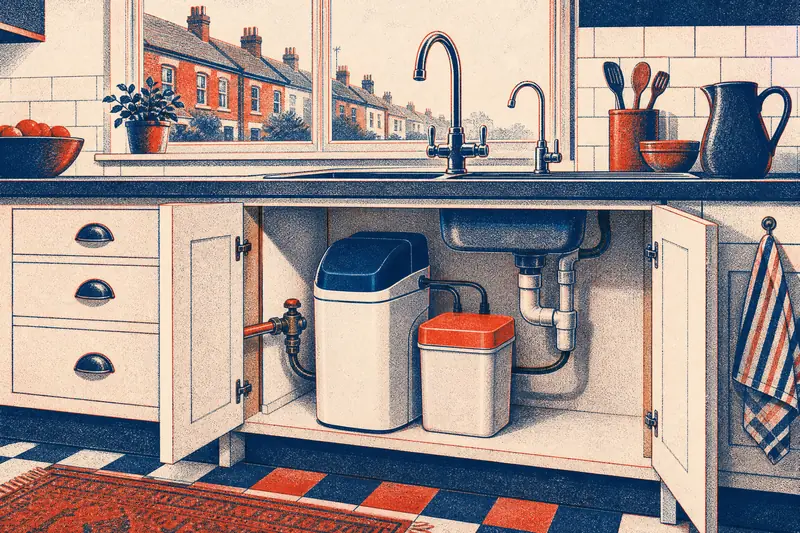
Magnetic and electronic units clamp onto or sit in the pipe and use a field or signal; the DWI's caution above applies. Salt-free conditioning tanks, which the US shops sell, are larger whole-house units filled with media. The EPA's WaterSense softener guide says such conditioners reduce scale "without added chemicals or water waste" and suggests looking for models that meet IAPMO/ANSI Z601, the standard for scale reduction devices.
When is a softener the better choice?
A softener is the better choice when you want limescale gone from every tap, shower and appliance rather than held back at the boiler. It is the only common type that removes the hardness, and at 263 to 310 mg/l the difference shows on glass shower screens and kettles as much as in the boiler.
The trade-offs run the other way. A salt softener needs a drain, salt, regular upkeep and notice to the water company under regulation 5 of the Water Fittings Regulations, which lists treatment units that produce a waste discharge or use water to regenerate. The DWI advises keeping the kitchen drinking tap unsoftened, and Worcester Bosch and Baxi want the boiler's heating circuit filled with unsoftened water.
If only the combi's hot water matters, a reducer on its cold feed is the smaller job. If the whole house matters, read the water softeners page and the softener size page.
Scale soundings
- 200 ppmADL's definition of hard water, as CaCO3ADL Vol 1, Appendix A
- 263 mg/lSoftest Portsmouth Water zone average, 2026Portsmouth Water
- 267 ppmVaillant's threshold, 15 °dHVaillant ecoTEC plus manual
- 4Inhibitor types Worcester calls suitableWorcester Bosch TB 0072a
Which salt-free conditioners do the US shops list?
Both US shops sell salt-free conditioners as an alternative to a softener. The SoftPro FORTRESS Salt-Free Water Conditioner (SoftPro Water Systems, a US shop with the same owners as this site) is described as designed to "manage mineral buildup without the use of salt", in Home (6 US gallons a minute, about 23 litres), Pro (10, about 38 litres) and Commercial sizes. Quality Water Treatment's SoftPro Elite salt-free unit (Quality Water Treatment, a US shop with the same owners as this site) is titled a "salt-free water softener", although by the definitions above it is a conditioner. Neither listing, as read in October 2026, names a Z601 certificate. They appear here as US reference models, not as products for a UK home.
Any unit fitted in England has to meet the Water Fittings Regulations, and anything that discharges waste water or regenerates must be notified first, so a UK reader should look for a unit the installer can show complies.
Where these figures come from
Based on Approved Document L Volume 1 (2021 edition incorporating 2023 amendments, para 8.8 and Appendix A; 2026 edition, para 7.8(c)), Portsmouth Water's 2026 hardness table, the DWI hardness page, the EPA's WaterSense guide to softeners (May 2026), Worcester Bosch's TB 0072a, Greenstar 4000 installation manual and hot-water heat exchanger cover terms, Vaillant's ecoTEC plus installation manual (2024), Baxi's 600 Combi 2 manual, reg 5 of the 1999 Water Fittings Regulations and both US shops' listings, all read in October 2026. Left out: claims about how any device changes mineral structure, savings or payback figures, prices for fitting, and warranty terms beyond the Worcester page quoted.
Further questions
Does a scale reducer need replacing?
Follow the maker's instructions for any cartridge or media it uses. Ask the installer which type was fitted and record it with the boiler paperwork.
Can you fit a scale reducer to an existing combi?
Yes, a reducer can be added to the cold feed of a boiler already in place; it is plumbing on the water side, not work inside the gas appliance. Work inside the boiler itself is for a Gas Safe registered engineer.
Will a scale reducer remove scale that is already there?
The sources here describe reducers as preventing or limiting new scale. Scale already in a heat exchanger is a descaling or replacement job, as Vaillant's fault table puts it.
Is polyphosphate safe in drinking water?
No primary source opened for this page covers the safety of polyphosphate dosing at a drinking tap. Ask the maker for its UK compliance evidence before fitting one on a line that feeds the kitchen tap.
Do scale reducers work with an unvented cylinder?
Makers of cylinders set their own conditions. One Worcester Bosch cylinder manual says that where hardness is very high, over 450 ppm, a softener must be used; that is above every Portsmouth Water zone. The unvented cylinders page covers the safety rules.
Does a scale reducer need a drain?
Polyphosphate, magnetic and electronic units do not. A salt softener does, which is one reason it falls under the notification rule.
Read on