Powerflushing: Signs, Methods and Limits
In short
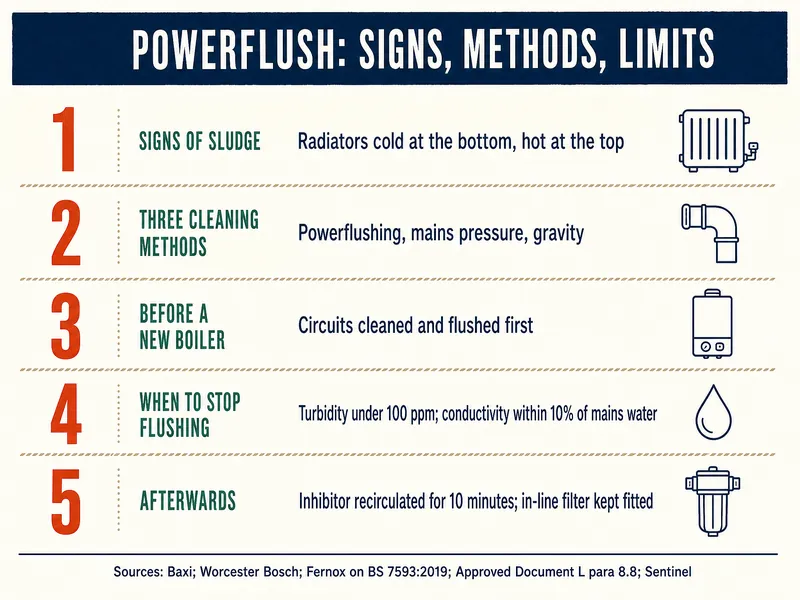
A powerflush is one of three cleaning methods named in summaries of BS 7593:2019; it makes sense when radiators show sludge signs, and some cleaning is expected before any new boiler goes on.
Chalk & Cistern notes · checked and updated
On this page
A heating circuit is a sealed loop of steel radiators, copper pipe and a pump, and over the years it collects black sludge. A powerflush pushes that sludge out at high flow with cleaning chemicals, then leaves the water dosed with inhibitor. Chalk & Cistern sets out what makers and the building guidance say about it, where the hard water of south-east Hampshire comes in, and what a flush cannot do.
In brief
- Summaries of BS 7593:2019 name three recognised cleaning methods: powerflushing, mains pressure and gravity cleaning (Fernox, 2019).
- Approved Document L, para 8.8, says heating and primary hot-water circuits should be thoroughly cleaned and flushed before a new heating appliance is installed.
- Sentinel's guide says a powerflush "can take several hours" and runs until turbidity reads under 100 ppm.
- Baxi lists eight sludge signs, starting with radiators that are hot at the top and cold at the bottom.
- Vaillant's ecoTEC plus storage combi manual expects untreated fill water under 300 ppm on a typical small system; Portsmouth Water's 2026 zones run 263–310 mg/l.
- No price is given here: no primary source publishes one.
What is a powerflush?
A powerflush is a deep clean of the heating circuit: a pump unit is connected to the system, cleaning chemical is circulated at high flow, and the dirty water is dumped until it runs clear. It is one of the cleaning methods that Fernox's summary of BS 7593:2019 lists, alongside mains-pressure and gravity cleaning.
BS 7593 is the British Standard code of practice for preparing, commissioning and maintaining domestic central heating; the current edition on BSI's site is BS 7593:2019+A1. It is a standard, not a law. Building guidance points to it, and many makers tie their warranties to it.
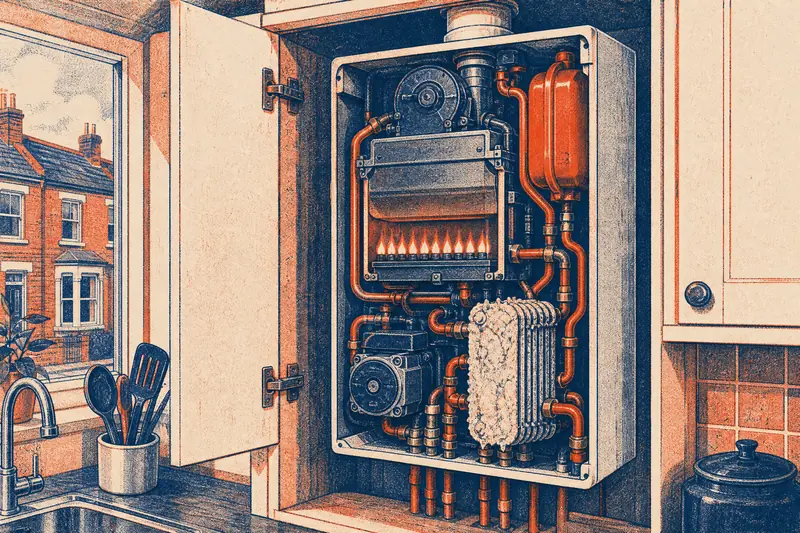
The flush cleans the heating water only. Water from your hot taps on a combi boiler never enters that loop, so a flush does nothing for limescale on the hot-water side (the combi boilers page covers that).
What are the signs of sludge?
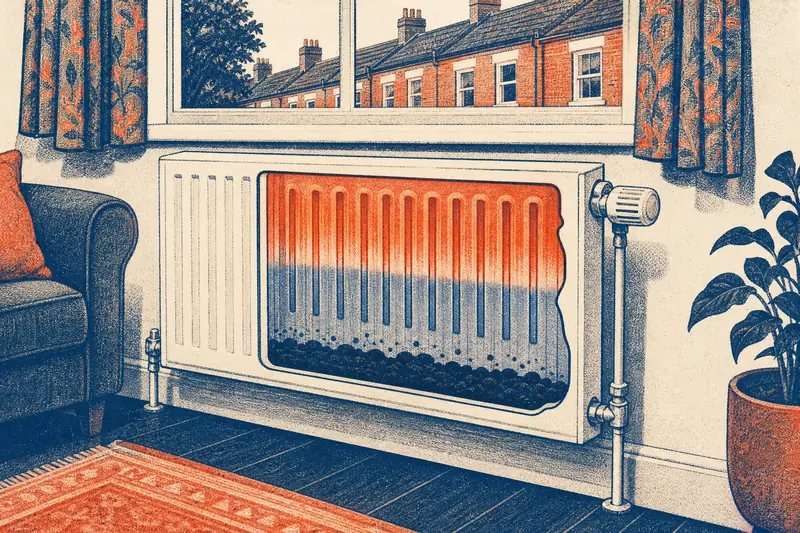
The classic sign of sludge is a radiator that is hot at the top and cold at the bottom, because the sediment settles low in the panel. Baxi's sludge FAQ gives the full list:
- radiators hot at the top but cold at the bottom;
- radiators that need bleeding more often;
- pipes to a radiator get hot but the radiator does not;
- some radiators never reach temperature, even turned up;
- the pump leaks or fails;
- parts taken out of the boiler come out full of dirt;
- the flow pipe is hot while the return is lukewarm or cold;
- the system gurgles or "kettles".
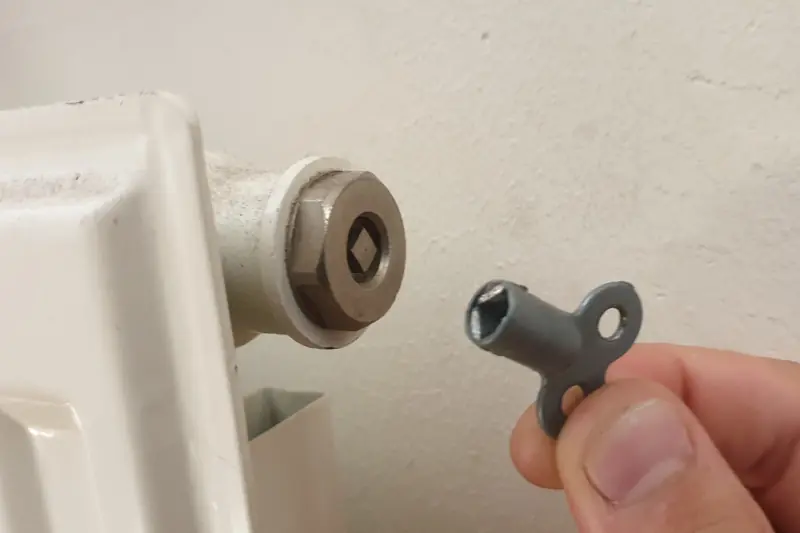
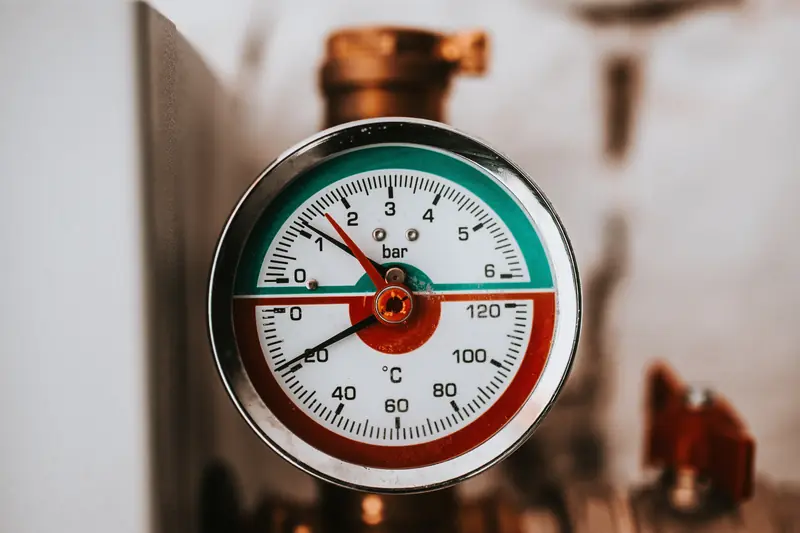
Worcester Bosch makes the same point about the cold-bottomed radiator. Cold at the top is different: that is usually air, and bleeding fixes it. Bleeding drops the system pressure, so check the gauge afterwards; the boiler pressure page explains how to top up from the filling loop as your maker's user guide describes.
Which cleaning methods are there besides a powerflush?
Besides a powerflush, BS 7593 summaries name mains-pressure cleaning and gravity cleaning. Fernox's article says installers "should use a recognised cleaning method", naming those three, without ranking them.
As the names suggest, a mains-pressure clean uses the incoming water pressure to move water and cleaner through the circuit, a gravity clean drains and refills it, and a powerflush brings its own pump for higher flow. Which suits your house is a judgement for the heating engineer, and the standard leaves room for it.
Sentinel's powerflush guide describes the job end to end and warns that larger or dirtier systems take longer.
Is a powerflush needed with a new boiler?
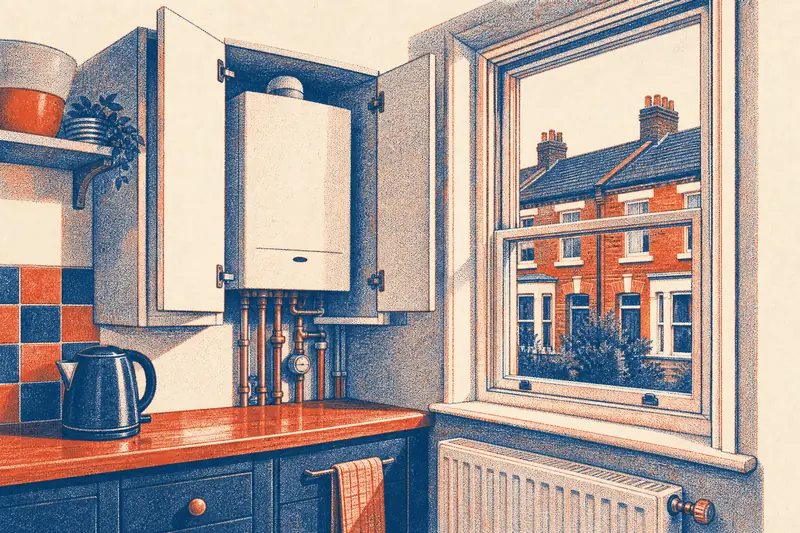
Some form of cleaning is expected with a new boiler, though not necessarily a powerflush. Approved Document L, Volume 1 (the 2021 edition as amended in 2023), para 8.8, says all central heating and primary hot-water circuits should be thoroughly cleaned and flushed out before a new heating appliance is fitted, that an inhibitor should be added, and that systems should be prepared and commissioned to BS 7593.
Fernox adds that systems should be cleaned before the boiler goes on, so loosened debris does not land in a brand-new heat exchanger. Sentinel notes that many boiler makers now make the warranty depend on cleaning to BS 7593 and Part L. Ask the installer which method they used and for the completed Benchmark commissioning checklist, which ADL names as a way to show commissioning was done.
Anything inside a gas boiler stays with a Gas Safe registered engineer. The heating hub explains where each job sits.
How long does a powerflush take, and when is it finished?
A powerflush "can take several hours", according to Sentinel, and longer on big or heavily fouled systems. It is finished when the water tests clean, not after a set time.
Sentinel gives two end-points: flush until a turbidity reading under 100 ppm, and until the system water's conductivity is within 10% of the mains water supplied to the property. Then a high-quality inhibitor is added through the flushing unit and recirculated for 10 minutes. Asking for those readings is a fair way to check that the job was done to the maker's method.
How do you keep a system clean after a powerflush?
Keeping a system clean after a powerflush comes down to inhibitor, a filter and few top-ups. Fernox's BS 7593 summary says an in-line filter should be permanently installed and serviced when the system is recommissioned; Baxi says a magnetic filter catches the particles before they reach the boiler.
Every refill brings in fresh mains water and dilutes the inhibitor. Worcester Bosch's Greenstar 8000+ instructions say constant re-pressurising should be investigated, as it signals a possible leak and weakens inhibitor protection. Vaillant's ecoTEC plus storage combi manual asks for the heating water to be treated once total fill and top-up water over the system's life passes three times its volume, and to clean and inhibit, or fit a magnetite separator, if magnetite is found.
Hard water matters here too. The same Vaillant manual allows untreated fill water under 300 ppm as calcium carbonate for a system under 50 kW holding up to 20 litres per kW, and 200 ppm for one holding 20 to 50 litres per kW. Portsmouth Water's 2026 zone table runs from 263 to 310 mg/l (about 18–22 °Clark), so Worlds End sits above the first figure and every zone sits above the second. Softened water is no shortcut: Worcester says to fill and top up the heating with untreated water through a bypass where a softener is fitted (see the water softeners page).
What can't a powerflush fix?
A powerflush cannot fix a leak, a failed part or limescale in a combi's hot-water side. If the pressure keeps falling, Baxi's user guide says a fault or leak is indicated, and flushing will only empty the inhibitor faster.
A pump that has already failed, a radiator rusted through from inside, or a valve that will not open needs replacing, not flushing. Cleaning can also expose weak spots that sludge was sealing. And because the hot-water side of a combi is separate, scale there needs the treatment Approved Document L asks for in hard-water areas, covered on the hard water page.
What the cleaning sources say
- 3Cleaning methods named: powerflushing, mains pressure, gravityFernox on BS 7593:2019
- 100 ppmTurbidity reading to flush belowSentinel powerflush guide
- 10%Conductivity gap from mains water at the end of a flushSentinel powerflush guide
- 300 ppmVaillant's untreated fill-water limit, typical small systemVaillant ecoTEC plus manual
- 263–310 mg/lHardness across Portsmouth Water's 15 zones, 2026Portsmouth Water
| Source | What it says | Document |
|---|---|---|
| Approved Document L, Vol 1 | Clean and flush before a new appliance; add inhibitor; systems commissioned to BS 7593 | Para 8.8, 2021 edition with 2023 amendments |
| Fernox | Powerflushing, mains pressure or gravity; permanent in-line filter | BS 7593:2019 article, June 2019 |
| Sentinel | Several hours; under 100 ppm turbidity; conductivity within 10% of mains; inhibitor for 10 minutes | Powerflush how-to guide |
| Baxi | Eight sludge signs; magnetic filter catches particles | Sludge FAQ |
| Worcester Bosch | Constant topping up signals leaks and weakens inhibitor; fill with untreated water | Greenstar 8000+ instructions, 2024 |
| Vaillant | Treat water past three system volumes of top-up; clean or fit a separator if magnetite found | ecoTEC plus storage combi manual |
Where these figures come from
This page draws on Approved Document L Volume 1 in its 2021 edition with 2023 amendments, BSI's listing for BS 7593:2019+A1, Fernox's 2019 summary of that standard, Sentinel's powerflush guide, Baxi's sludge FAQ and 400 Combi 2 user guide, Worcester Bosch's Greenstar 8000+ user instructions (2024) and radiator FAQ, Vaillant's ecoTEC plus storage combi installation manual and Portsmouth Water's 2026 hardness table, all read in October 2026. The text of BS 7593 itself is paywalled, so only makers' summaries of it are used. Left out: prices for powerflushing (none published by a primary source), claims about energy savings, and any step inside a gas boiler.
Further questions
How often does a heating system need a powerflush?
No source sets a routine interval. Makers point to cleaning when a new boiler goes on and when sludge signs appear; in between, a filter and a maintained inhibitor level are meant to keep the water clean.
Can a powerflush damage old radiators or pipes?
A flush can reveal weak points that sludge had been plugging, such as a radiator corroded from inside. That is a reason to ask about the system's age and condition before the work, not a reason to leave sludge in place.
Do you need a powerflush for a single cold radiator?
Not always. One radiator cold at the top usually needs bleeding; one cold at the bottom may have sludge, and a heating engineer may clean just that radiator or the whole system depending on what the water looks like.
Is a powerflush the same as a chemical flush?
No. A chemical clean circulates cleaner through the system under its own pump or by gravity and drains it; a powerflush adds an external pump for higher flow. Both are named among the recognised methods in summaries of BS 7593:2019.
Does a magnetic filter replace a powerflush?
A filter catches particles as they circulate, which helps keep a clean system clean. It does not shift sludge already settled in radiators, which is the job of a full clean.
Should softened water be used to refill after a flush?
Not without checking the boiler maker's instructions. Worcester Bosch's Greenstar 8000+ instructions say to fill and top up the heating with untreated water through a bypass where a softener is fitted, and Baxi wants the filling point upstream of the softener; other manuals word it differently, so check yours.
Will a landlord need a powerflush certificate?
No regulation opened for this page asks for one. Landlords have repair duties for heating and hot water and an annual gas safety check, covered on the landlords page.
Read on
Back to the Chalk & Cistern front page