Combi Boilers in a Hard-Water Area
In short
Combi boilers heat tap water through a small plate heat exchanger, and on Portsmouth's 263 to 310 mg/l water Approved Document L expects that hot-water side to be treated against limescale.
Chalk & Cistern notes · checked and updated
Shop links on this page: Chalk & Cistern is owned by the same people as SoftPro Water Systems and Quality Water Treatment, the two US water-treatment shops linked on this page. They appear only as US reference models, and what a shop says about its products is reported as its claim. How shop links work
On this page
In brief
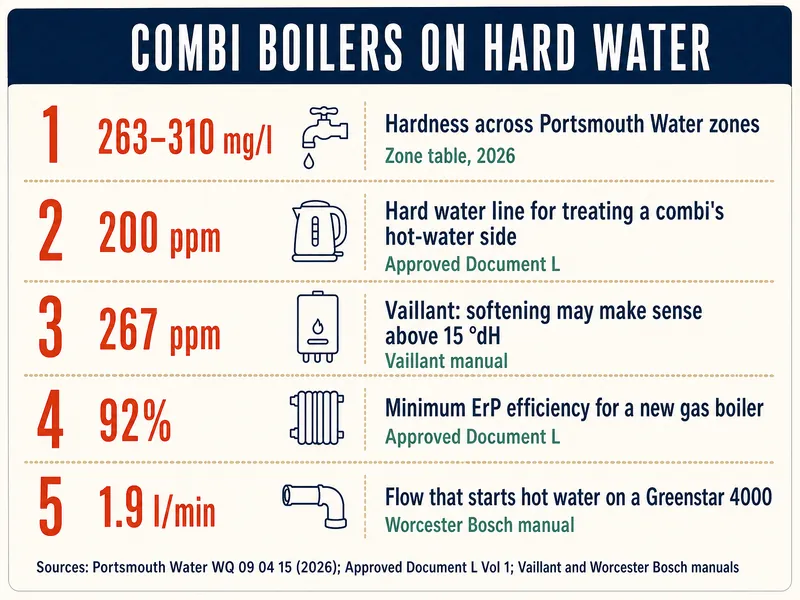
- Every Portsmouth Water zone averages 263–310 mg/l (as calcium carbonate, zone table, 2026), above the 200 ppm line in Approved Document L.
- Approved Document L para 8.8: in hard water areas, the hot-water circuit of a combi "should" be treated to reduce limescale.
- Worcester Bosch ties its hot-water heat exchanger cover to temporary hardness of 200 ppm; Vaillant says softening "may make sense" above 15 °dH (267 ppm).
- Baxi and Worcester Bosch both want the sealed heating circuit filled from an unsoftened supply.
- A new gas boiler must reach at least 92% ErP seasonal efficiency (Approved Document L, Tables 6.1 and 6.2).
- Anything inside the boiler casing is work for an engineer on the Gas Safe Register.
How does a combi boiler heat water?
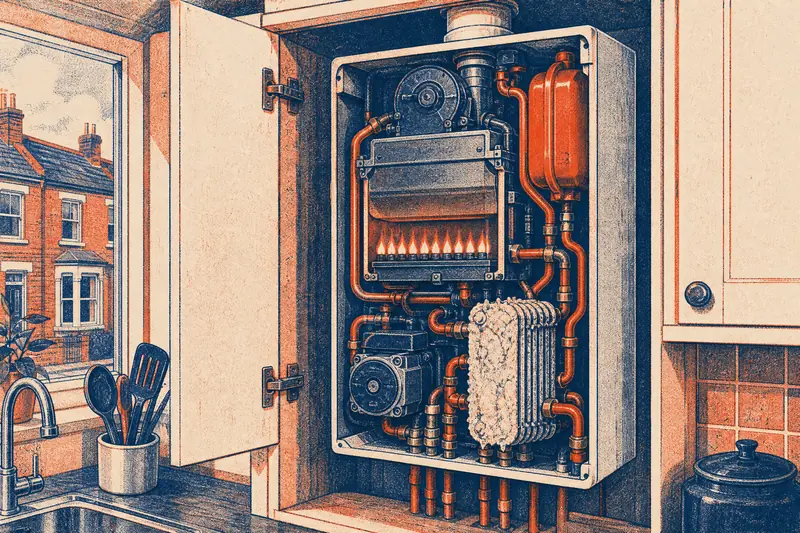
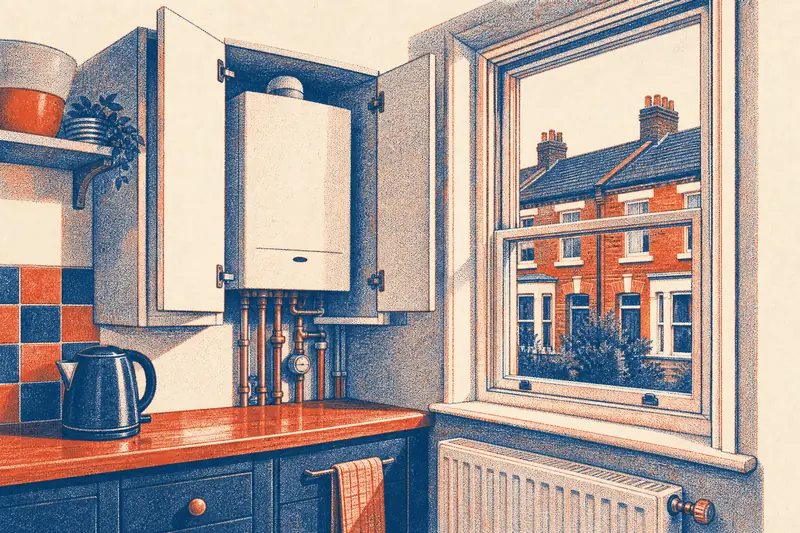
A combi boiler heats tap water on demand by passing it through a plate heat exchanger, with no hot water cylinder. Baxi's 600 Combi 2 installation manual describes the sequence: a flow sensor detects that a hot tap has been opened, the control board switches a three-way valve to the hot-water position, and the boiler's heat goes to the plate heat exchanger. Hot water takes priority over the radiators while the tap runs.
The flows are modest. Worcester Bosch's Greenstar 4000 installation manual lists 1.9 litres a minute as the minimum flow to start hot water, and a maximum of 11 litres a minute at a 40 °C rise for the 30 kW model, 9 for the 25 kW model. Its hot-water temperature range is 35 to 60 °C.
That small plate exchanger is the part hard water targets: fresh mains water runs through it each time a hot tap opens.
Combi figures
- 263–310 mg/lhardness across Portsmouth Water's zones, 2026Portsmouth Water WQ 09 04 15
- 200 ppmApproved Document L's definition of hard waterApproved Document L Vol 1, 2021 incl. 2023 amendments
- 267 ppmVaillant: softening "may make sense" above 15 °dHVaillant ecoTEC plus installation manual, 2024
- 92%minimum ErP efficiency for a new gas boilerApproved Document L Vol 1, Tables 6.1–6.2
What does hard water do to a combi boiler?
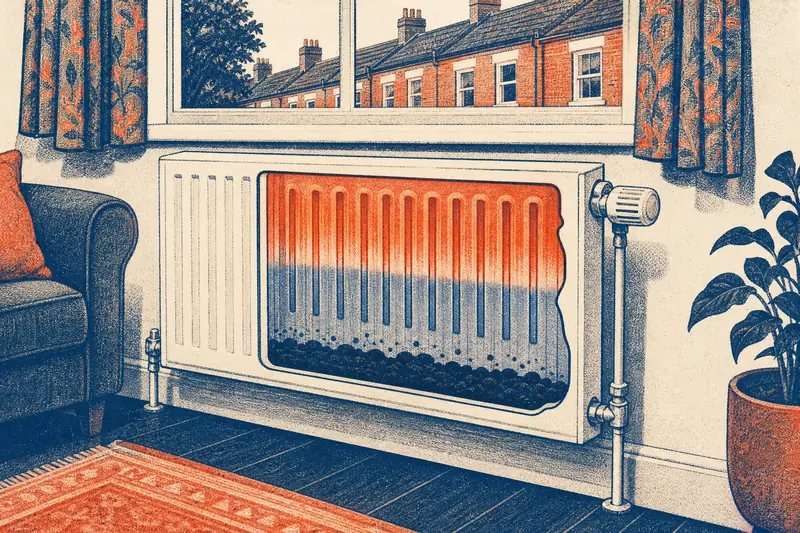
Hard water leaves limescale in the hot-water heat exchanger, which cuts hot-water performance and can mean descaling or replacing the part. The DWI explains the chemistry: "temporary hardness", from calcium and magnesium carbonates and bicarbonates, comes out of water as scale when it is heated. Vaillant's installation manual adds that "scale deposition increases as the water temperature increases".
The makers' own fault tables show where it ends up. Vaillant lists "Scale in the secondary heat exchanger" as a cause, with the remedy "Descale or, if required, replace the affected heat exchanger". Worcester Bosch's service steps for a combi whose hot-water volume falls short begin with checking the plate heat exchanger, then descaling it or replacing it.
Portsmouth's water is firmly in this territory. Portsmouth Water's 2026 table puts every one of its 15 zones between 263 and 310 mg/l, hard to very hard on the DWI scale; the city zones, including Southsea, run 277 to 282. How hard Portsmouth's water is has the full table and limescale covers what the same scale does to kettles and taps.
What does Approved Document L say?
Approved Document L expects scale treatment on a combi's hot-water side in any hard water area. Paragraph 8.8 of the 2021 edition incorporating 2023 amendments says: "In hard water areas, suitable measures should be taken to treat the feed water to water heaters and the hot water circuit of combination boilers to reduce limescale accumulation." Its key terms define hard water as "greater than 200ppm of CaCO3".
Since every Portsmouth Water zone averages over 263 mg/l, the whole supply area counts. The same paragraph asks for the heating circuit to be cleaned and flushed before a new boiler goes in, a chemical inhibitor added, and the system commissioned to BS 7593. The 2026 edition repeats the hard-water wording at para 7.8(c), for work under the newer standards.
The Benchmark commissioning checklist that comes with Worcester Bosch and Vaillant boilers asks whether the home is in a hard water area, which it sets at above 200ppm, and then whether a scale reducer or softener is pre-existing, fitted or not required. In Portsmouth the honest answer to the first question is yes, so ask to see what was ticked.
Paragraph 6.2 adds a separate rule for a gas combi fitted in an existing home: at least one extra energy measure, from flue gas heat recovery, weather compensation, load compensation, or a smart thermostat with automation and optimisation.
What do boiler makers ask for in hard water?
Each maker words it differently, so read your own boiler's manual rather than one merged rule.
| Document | On scale | On softened water in the heating circuit |
|---|---|---|
| Worcester Bosch Greenstar 4000 manual (2021) | Over 200 ppm temporary hardness, "consideration may need to be given to the fitting of a scale prevention device" | Greenstar 4000 manual: heating must not be filled with salt-softened water, though occasional topping up is tolerated |
| Worcester Bosch hot-water heat exchanger cover terms | Over 200 ppm temporary hardness, mains water "must be protected by a suitable scale prevention device" | Not covered |
| Vaillant ecoTEC plus manual (2024) | Above 15 °dH (267 ppm), softening "may make sense" or, for hot water, "may be necessary" | Gives fill-water hardness limits by system size (storage combi manual) |
| Baxi 600 Combi 2 manual (2023) | Section headed "Hard water area"; no ppm figure | Fill only with water that has "NOT been artificially softened", from upstream of any softener |
Worcester Bosch's heat exchanger cover terms, on its professional site, are the firmest: temporary hardness "must not exceed 200ppm" unless a suitable scale prevention device protects the mains feed. Worcester's 2014 Technical Bulletin TB 0072a lists magnetic, electronic, electrolytic and polyphosphate scale inhibitors as "suitable to be used with Worcester appliances", and says polyphosphate units "do not require a bypass or untreated line".
A salt softener is the other route. Where one is fitted, the makers word it differently: the Greenstar 4000 manual tolerates occasional softened top-ups, the Greenstar 8000+ instructions ask for a bypass so the heating is both filled and topped up with untreated water, and Baxi says the fill point must be upstream of the softener. Follow your own boiler's manual. Scale reducers compares the devices and water softeners covers the softener side.
Two US reference models show the difference in kind. The SoftPro Fortress salt-free conditioner (SoftPro Water Systems, a US shop with the same owners as this site) is a cartridge conditioner sold to "manage mineral buildup without the use of salt"; the SoftPro ECO softener at Quality Water Treatment (Quality Water Treatment, a US shop with the same owners as this site) is an ion-exchange salt softener in 32,000 to 64,000-grain sizes. Neither is UK stock. A UK installation must meet the Water Supply (Water Fittings) Regulations 1999, and a regenerating softener is on the regulation 5 notification list, item 4(f), so look for a unit the installer can show complies.
What efficiency must a new boiler meet?
A new gas boiler must reach at least 92% seasonal efficiency as defined in ErP, in both new and existing homes, under Tables 6.1 and 6.2 of Approved Document L. Only in exceptional circumstances in an existing home does a lower SEDBUK 2009 figure of 78% for natural gas apply.
Paragraph 5.9 asks that a combi be chosen to "modulate down to the typical heating load of the dwelling".
How do you look after a combi?
Keep the gas work for a Gas Safe registered engineer and the water side in good order. Under regulation 3 of the 1998 gas safety rules anyone doing gas work must be competent, and anyone doing it as a business must be a member of the HSE-approved class, which is the Gas Safe Register; its ID card page explains how to check an engineer.
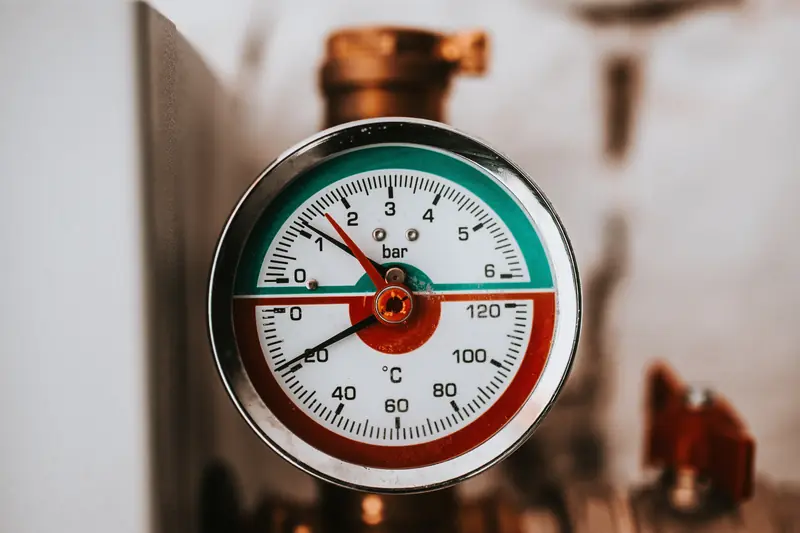
What a householder can do is listed in the user manual. Watch the heating pressure, which most makers want at about 1 to 1.5 bar when cold, and top it up as the manual shows; boiler pressure covers the steps. Worcester Bosch warns that frequent topping up dilutes the inhibitor and points to a leak. In a freeze, its Greenstar 8000+ instructions say a frozen condensate pipe "will cause the boiler to shut down", and only one at ground level and easily reached should be thawed, never with boiling water.
Inhibitor and cleanliness come from the installer. Fernox's summary of BS 7593:2019 calls for a permanently fitted in-line filter, and Approved Document L says systems should be commissioned to BS 7593. Signs of sludge and the cleaning methods are on powerflushing; the boilers and hot water hub links the rest of the group.
Where these figures come from
Based on Approved Document L Volume 1 (2021 edition incorporating 2023 amendments, paras 5.9, 6.2 and 8.8, Tables 6.1 and 6.2; 2026 edition para 7.8(c)), Portsmouth Water's 2026 hardness table (WQ 09 04 15), the DWI hardness page, the Worcester Bosch Greenstar 4000 and 8000+ manuals, its heat exchanger cover terms and Technical Bulletin TB 0072a (2014), the Vaillant ecoTEC plus installation manual (2024), the Baxi 600 Combi 2 manual (2023), Fernox's BS 7593 summary and the 1998 gas safety regulations, read in October 2026. Left out: boiler and installation prices, warranty lengths, brand comparisons and any savings figure for scale control, since none is published by a primary source.
Further questions
Is a scale reducer a legal requirement on a combi in Portsmouth?
Approved Document L, the official guidance on the energy part of the Building Regulations, says scale treatment "should" be applied to a combi's hot-water circuit in hard water areas. Every Portsmouth Water zone is over its 200 ppm line, so expect the installer to address it on the Benchmark checklist.
Does an existing softener cover a new combi?
It can count as the scale-control measure on the Benchmark checklist, which offers "pre-existing" as an answer. The heating circuit still needs filling from an unsoftened supply or the softener's bypass, as Worcester Bosch and Baxi both say.
Can a combi's plate heat exchanger be descaled?
Yes, by an engineer. Worcester Bosch's manual says descale it with an agent approved for stainless steel or replace it, and Baxi's manual describes cleaning it with a descaling product such as formic or citric acid. Both jobs open the casing, so they are not householder tasks.
Does softened water damage a combi?
Not on the tap side, which is where makers want scale control. The concern is the sealed heating circuit: Worcester Bosch says it must not be filled with salt-softened water (the Greenstar 8000+ instructions extend that to topping up), and Baxi wants the filling point upstream of any softener. Your own manual decides.
Do magnetic or electronic scale reducers work with combis?
Worcester Bosch's 2014 bulletin calls magnetic, electronic, electrolytic and polyphosphate inhibitors suitable for its appliances. The DWI says magnetic and electronic devices "do not soften the water" and advises buying on a sale-or-return basis.
Who must have a combi checked every year?
Landlords. Regulation 36 of the 1998 gas safety rules requires a safety check at intervals of no more than 12 months on appliances in let homes, covered on landlord gas safety and water duties. For owner-occupiers, servicing intervals are set by the maker's own terms in the manual.
Next pages
Back to the Chalk & Cistern front page