Unvented Hot Water Cylinders
In short
Unvented cylinders store hot water at mains pressure, so Approved Document G3 treats fitting one as notifiable work needing two separate safety devices, a visible tundish and a safe discharge route, with servicing every year.
Chalk & Cistern notes · checked and updated
On this page
- What is an unvented cylinder?
- Who is allowed to fit an unvented cylinder?
- What safety devices must an unvented cylinder have?
- Where does the discharge pipe go?
- How often should an unvented cylinder be serviced?
- What does hard water do to an unvented cylinder?
- How hot should the stored water be?
- Further questions
An unvented cylinder is a sealed hot-water store fed straight from the mains, with no cold tank in the loft. That gives strong showers on every floor, and it also means a vessel of hot water under pressure in a cupboard. The building rules for it sit in Part G of the Building Regulations, and the makers add their own conditions. Chalk & Cistern sets out both, plus what the hard water across Portsmouth Water's area means for a cylinder.
In brief
- Installing an unvented system is notifiable building work unless the installer belongs to a competent person scheme (Approved Document G, paras 3.41–3.42).
- The cylinder needs at least two safety devices that work separately from its thermostat and from each other (ADG paras 3.17–3.18).
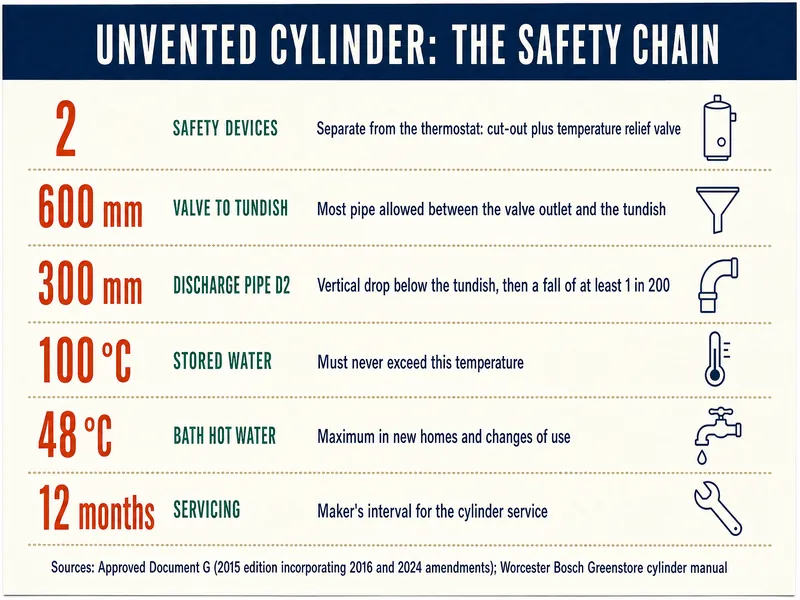
- No more than 600 mm of pipe may run from the relief valve to the tundish, and the D2 pipe below it drops at least 300 mm before a fall of at least 1 in 200.
- Requirement G3(3): stored water must never exceed 100 °C; G3(4) caps hot water to a bath at 48 °C in new homes and changes of use.
- Worcester Bosch asks for the cylinder to be serviced annually and a softener where hardness passes 450 ppm.
- Every zone in Portsmouth Water's 2026 table sits between 263 and 310 mg/l, over the 200 ppm hard-water line in Approved Document L.
What is an unvented cylinder?
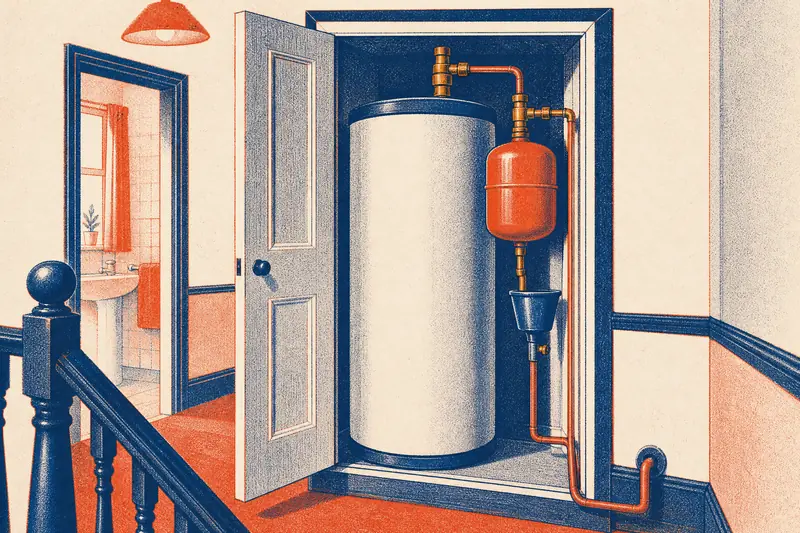
An unvented cylinder is a hot-water storage vessel connected directly to the cold mains, so it delivers hot water at close to mains pressure instead of relying on a loft tank and gravity. Heat comes from a boiler coil, an immersion heater or both.
Because the water cannot vent to a tank, it has nowhere to go when it expands as it heats. An expansion vessel takes up that extra volume, and relief valves open if pressure or temperature climbs too far. Worcester Bosch's Greenstore cylinder manual lists a combined temperature and pressure relief valve set at 90 °C and 7 bar, an expansion relief valve at 6 bar and an expansion vessel pre-charged to 3 bar for that range; other makers' figures differ.
Performance depends on what the mains delivers. Portsmouth Water's leaks, pressure and pipes page sets its minimum at 1 bar measured at its stop tap, with flow that would fill a 9-litre bucket in about a minute. Each cylinder maker sets its own minimum, so ask the installer to measure pressure and flow at your house before choosing one.
Who is allowed to fit an unvented cylinder?
An unvented cylinder should be fitted by someone with the specific skills, and the work must reach building control one way or another. Approved Document G (2015 edition incorporating 2016 and 2024 amendments), para 3.40, tells owners to choose installers who can show competence, through a competent person scheme or a current registered operative skills card for unvented hot water systems.
Para 3.41 says installing an unvented system is notifiable building work that must be notified to the building control body before work starts. Para 3.42 gives the exception: if the installer is registered with a competent person scheme, no advance notice is needed and the owner receives a building regulations certificate of compliance.
Para 3.78 adds deadlines for the commissioning notice: within 30 days of completion under a competent person scheme, or within 5 days on the building notice or full plans route. The gov.uk page for Approved Document G shows the current version, updated 1 October 2024. Keep that certificate with the house papers.
What safety devices must an unvented cylinder have?
An unvented cylinder must have at least two safety devices that act on their own, in addition to its thermostat. ADG paras 3.17–3.18 describe the usual pair: a non self-resetting energy cut-out, and a temperature relief valve or a combined temperature and pressure relief valve.
The thermostat is the everyday control; the cut-out shuts off the heat source if the thermostat fails; the relief valve dumps water if both fail. Requirement G3(3) is the outcome all of this protects: the stored water must not exceed 100 °C at any time, and any discharge must be carried somewhere visible but safe.
Para 3.24 also asks for a warning label on the cylinder. In short, it tells the user that if hot water flows from the discharge pipe, they should switch the heater off and contact the installer.
Where does the discharge pipe go?
The discharge pipe takes water from the relief valves through a tundish, an open funnel where any flow can be seen, and on to a safe outlet. ADG para 3.50 calls the first length D1: a short metal pipe from the valves to the tundish.
Paras 3.54–3.55 put the tundish upright, in the same space as the cylinder, with no more than 600 mm of pipe between the valve outlet and the tundish, so a drip is visible. Para 3.56 sets the D2 pipe below it: a vertical section of at least 300 mm, then a continuous fall of at least 1 in 200. Para 3.61 says D2 ends where nobody nearby can be hurt by scalding water.
If you see water trickling into the tundish, something upstream has opened. Finding the cause is a job for the installer or a qualified engineer.
How often should an unvented cylinder be serviced?
An unvented cylinder should be serviced once a year, according to Worcester Bosch, whose Greenstore manual says to have the heating appliance and the hot-water cylinder serviced annually. Other makers set their own intervals and warranty conditions, so check the manual left with your cylinder.
Ask what the service covers: the relief valves, the expansion vessel's charge and the discharge route are the parts named on this page. No law opened for this page requires an owner-occupier to service a cylinder; the duty is practical and contractual. Landlords are different: the Landlord and Tenant Act 1985, s.11 makes them keep installations for heating water in repair and proper working order (see the landlords page).
If a cylinder heated by a gas boiler needs work on the boiler side, that part is a Gas Safe registered engineer's job. The boilers and hot water hub covers how the pieces fit together.
What does hard water do to an unvented cylinder?
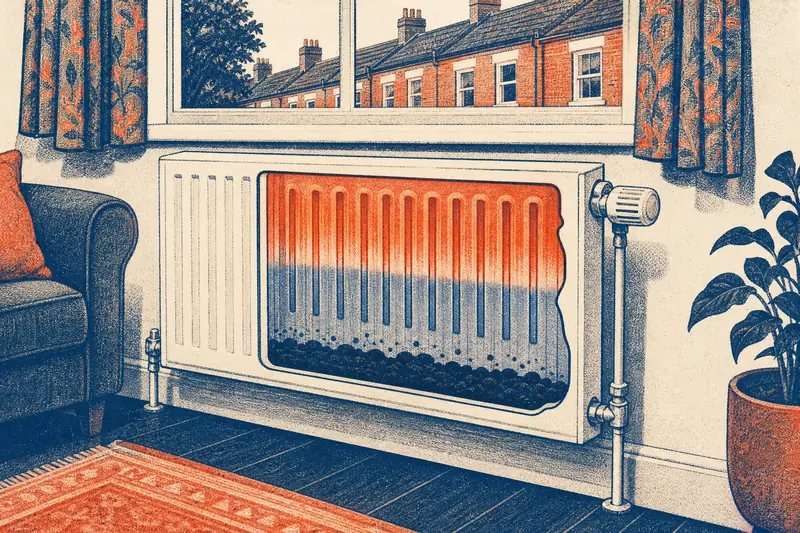
Hard water lays limescale on the heating coil and immersion element of an unvented cylinder, and scale builds faster as the water gets hotter. Every zone in Portsmouth Water's 2026 hardness table averages 263–310 mg/l as calcium carbonate (about 18–22 °Clark), and Portsmouth city's Farlington zones sit at 277–282 mg/l.
Approved Document L, Volume 1, para 8.8, says that in hard water areas (over 200 ppm) the feed water to water heaters should be treated to reduce limescale. Worcester's cylinder checklist asks the same question: is the installation in a hard water area above 200 ppm, and has a scale reducer been fitted?
Worcester's own softener threshold for the cylinder is much higher: a water softener must be used where hardness is over 450 ppm, and softened water should never go below 150 ppm. No Portsmouth Water zone reaches 450, so a scale reducer is the usual answer here, with a softener a choice rather than the maker's requirement. The hard water page and water softeners page cover both routes, and the combi boilers page has the makers' rules for the other common system.
How hot should the stored water be?
Stored hot water should be kept at 60 °C, according to the HSE's legionella guidance for landlords, which names that temperature for the cylinder. Vaillant's installation manual makes the same point the other way round: legionella multiply below 60 °C.
At the tap, lower is safer. Requirement G3(4) says hot water delivered to a bath in a new home, or one formed by a change of use, must not exceed 48 °C, and ADG para 3.65 expects a blending valve or similar device to do it.
Unvented cylinder figures
- 2Separate safety devices beyond the thermostatApproved Document G, paras 3.17–3.18
- 600 mmMost pipe allowed from relief valve to tundishApproved Document G, para 3.54
- 48 °CMaximum bath hot water, new homes and changes of useApproved Document G, requirement G3(4)
- 60 °CStorage temperature named for the cylinderHSE legionella guidance
- 450 ppmHardness above which Worcester requires a softenerWorcester Bosch Greenstore manual
| Rule | Figure or duty | Set by |
|---|---|---|
| Notifying building control | Before work, unless a competent person scheme installer | Approved Document G, paras 3.41–3.42 |
| Safety devices | At least 2, separate from the thermostat | Approved Document G, paras 3.17–3.18 |
| Tundish and D2 | 600 mm maximum to tundish; 300 mm vertical; fall 1 in 200 | Approved Document G, paras 3.54–3.56 |
| Bath temperature | 48 °C maximum, new homes and changes of use | Approved Document G, requirement G3(4) |
| Hard water treatment | Treat feed water to water heaters above 200 ppm | Approved Document L, para 8.8 |
| Servicing | Annually | Worcester Bosch Greenstore manual, 2017 |
Where these figures come from
This page is based on Approved Document G (2015 edition incorporating 2016 and 2024 amendments), Approved Document L (Volume 1, the 2021 text with its 2023 changes), the Worcester Bosch Greenstore cylinder manual (2017), Vaillant's ecoTEC plus installation manual, the HSE's legionella page for landlords (updated 2024), the Landlord and Tenant Act 1985 and Portsmouth Water's 2026 hardness table and pressure standard, all read in October 2026. Valve settings are for the Worcester range named, not every cylinder. Left out: installation prices, brand comparisons and any work inside a gas boiler.
Further questions
Can a homeowner fit an unvented cylinder themselves?
Approved Document G treats the installation as notifiable building work and asks owners to pick installers with proven skills, such as a registered operative skills card for unvented systems. Without a competent person scheme installer, building control must be told before work starts, and a self-fit is unlikely to satisfy the maker either.
Why is water dripping from the pipe outside?
Water from the discharge pipe means a relief valve has opened. The warning label ADG para 3.24 asks for says to switch the heater off and contact the installer, which is the right first move.
Does an unvented cylinder need a gas safety check?
The cylinder itself is not a gas appliance. A gas boiler that heats it falls under the landlord's annual gas safety check in a rented home, and its servicing is a Gas Safe registered engineer's work.
What is the expansion vessel for?
Water expands as it heats, and in a sealed system that extra volume needs somewhere to go. The vessel holds a cushion of air behind a membrane; Worcester's Greenstore range pre-charges it to 3 bar, so ask whether the yearly service checks it.
Does a new unvented cylinder have to have a blending valve?
Requirement G3(4) limits hot water to a bath to 48 °C when a home is newly built or formed by a change of use, and ADG suggests an in-line blending valve or similar. A cylinder replaced in an existing house is not caught by that requirement, though a blending valve is still worth asking about.
Will a scale reducer void a cylinder warranty?
Worcester's own checklist asks whether a scale reducer has been fitted in areas above 200 ppm, which suggests the maker expects one. Warranty terms vary by maker and were not opened for this page, so check yours.
Read on