Landlords: Gas Safety and Water Duties
In short
Landlord gas safety in England means a check by a Gas Safe registered engineer at least every 12 months, a copy to tenants within 28 days, and records kept for two years.
Chalk & Cistern notes · checked and updated
On this page
In brief
- Gas appliances and flues in a let home must be safety-checked no more than a year apart, under SI 1998/2451, regulation 36.
- Existing tenants get a copy of the record within 28 days of the check; each record is kept for 2 years.
- Since 1 October 2022, a carbon monoxide alarm is required in every room used as living accommodation that holds a fixed combustion appliance (gas cookers excepted).
- A landlord who breaches the smoke and carbon monoxide alarm rules faces a penalty charge of up to £5,000.
- The HSE says landlords must assess the legionella risk, but testing is "not usually required" for domestic hot and cold water.
- Section 11 of the 1985 tenancy repairs law makes the landlord keep the installations for water, gas, sanitation, space heating and hot water in repair and proper working order.
What gas safety checks must landlords do?
Landlords must have every gas appliance and flue they provide checked for safety, with no gap longer than 12 months between checks. That is regulation 36(3)(a) of the Gas Safety (Installation and Use) Regs (1998), and it applies whether the let is a Southsea flat, a shared house in Fratton or a family home in Fareham.
The paperwork matters as much as the visit. Each check's record has to be retained for 2 years, and every existing tenant must receive a copy within 28 days. The HSE's record-keeping page adds that a prospective tenant must get a copy before moving in, and that a check carried out up to two months early can keep the original anniversary date.
Only a Gas Safe registered engineer may do the check: the HSE puts it plainly, "All checks must be done by a Gas Safe registered engineer." Regulation 36(3) itself requires the check to be done by a Gas Safe registered engineer, and regulation 3 requires anyone doing gas work as a business to be on the register.
A check is not a service. The safety check confirms an appliance is safe to use; a maker's annual service is a separate thing, often tied to the warranty. The combi boilers and boiler pressure pages cover what tenants can safely do themselves, such as topping up pressure from the filling loop as the user guide describes.
Which carbon monoxide alarms are required?
Since 1 October 2022, landlords in England must fit a carbon monoxide alarm in any room used wholly or partly as living accommodation that has a fixed combustion appliance in it, gas cookers apart. The rule is in regulation 4 of the Smoke and Carbon Monoxide Alarm (England) Regulations 2015, as amended by the 2022 regulations.
In practice that covers a room with a gas boiler, a gas fire or a wood-burning stove, but not a kitchen whose only appliance is a gas hob or cooker. The same regulation requires a smoke alarm on every storey with a room used as living accommodation.
Alarms must also work. Where a tenant reports a faulty alarm on or after 1 October 2022, the landlord must repair or replace it. A local housing authority can impose a penalty charge, which under regulation 8 "must not exceed £5,000".
| Duty | What the law or guidance says | Source |
|---|---|---|
| Gas safety check | Every 12 months at most | Gas Safety Regs 1998, reg 36 |
| Gas safety record | Copy to existing tenants within 28 days; keep 2 years | Gas Safety Regs 1998, reg 36 |
| Carbon monoxide alarm | Each room used as living accommodation with a fixed combustion appliance, not gas cookers | Alarm Regs 2015, reg 4 |
| Smoke alarm | Each storey with living accommodation | Alarm Regs 2015, reg 4 |
| Legionella | Assess the risk; testing not usually required | HSE |
| Repairs | Water, gas, sanitation, heating and hot water installations | Landlord and Tenant Act 1985, s.11 |
Do landlords need a legionella risk assessment?
Yes: the HSE says landlords have "a duty to assess the risk from exposure to legionella to ensure the safety of their tenants". The same HSE page says this "does not require an in-depth, detailed assessment", and that testing is "not usually required for domestic hot and cold water systems". The law does not require a "legionella test certificate".
The HSE's short version of the controls is to "keep the hot water hot, cold water cold and keep it moving". For a stored hot water system, it advises setting the cylinder so water is stored at 60 °C. Showers and taps in rooms left empty between tenancies are the obvious places where water stops moving.
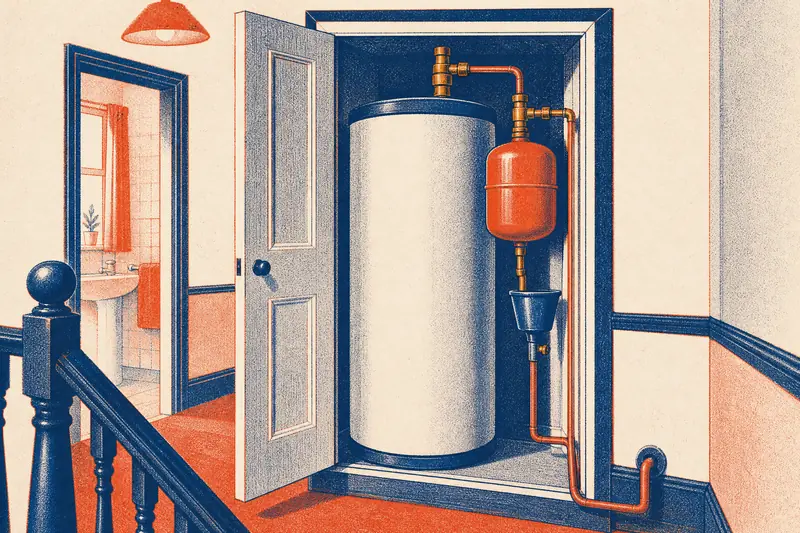
Homes with a hot water cylinder bring extra duties: an unvented cylinder needs a competent installer, and makers such as Worcester Bosch ask for an annual service. The unvented cylinders page covers those rules.
Which water and heating repairs fall to the landlord?
For most tenancies, the landlord must keep the installations for water, gas, electricity, sanitation, space heating and hot water in repair and proper working order. That is section 11 of the Landlord and Tenant Act 1985, which names basins, sinks, baths and toilets as part of sanitation.
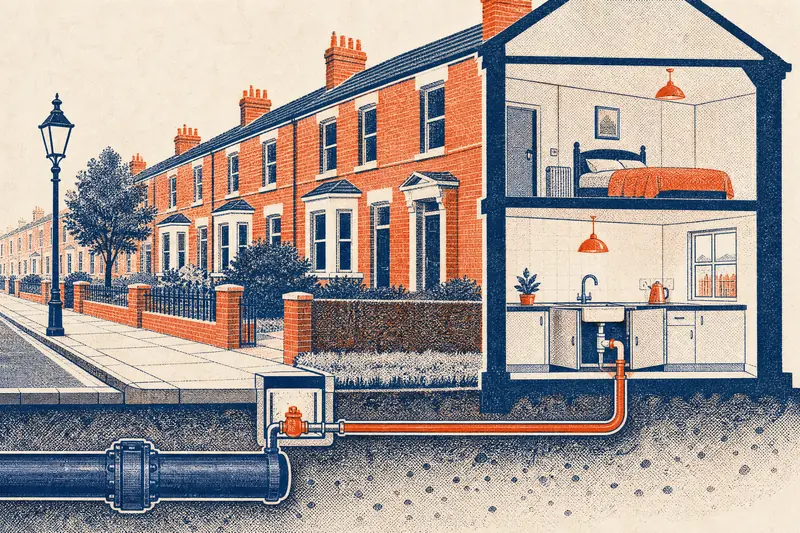
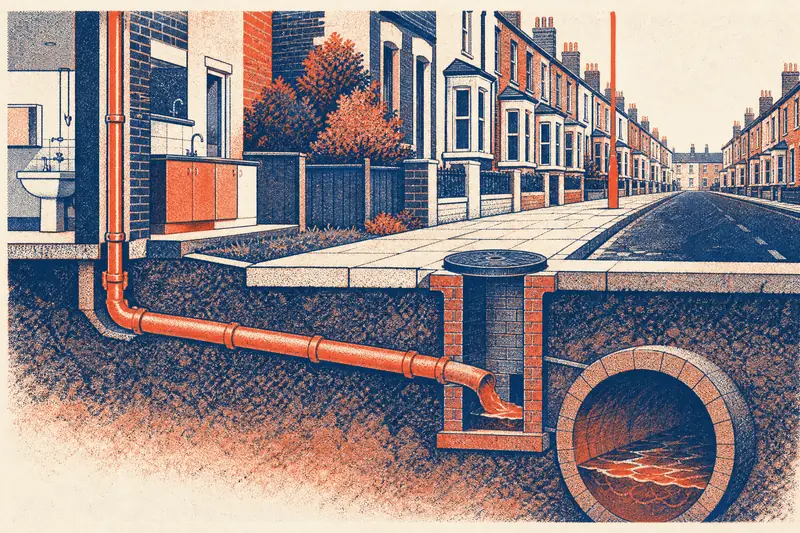
So a failed boiler, a leaking pipe in the wall, a broken stop tap or a blocked drain serving only the house is normally the landlord's problem, not the tenant's. Ownership of the pipes outside matters too. The underground supply pipe from the boundary to the house is the property owner's, and Portsmouth Water's leak help (£100 towards a repair or £200 towards replacing the whole supply pipe, if done within 30 days) excludes council and housing association premises. The water leaks and blocked drains pages explain where the owner's pipe ends.
Metering is now compulsory in Portsmouth Water's area, so a let home will sooner or later have a meter recording every litre. The water meters page shows how to read one at the start and end of a tenancy.
Landlord duties in numbers
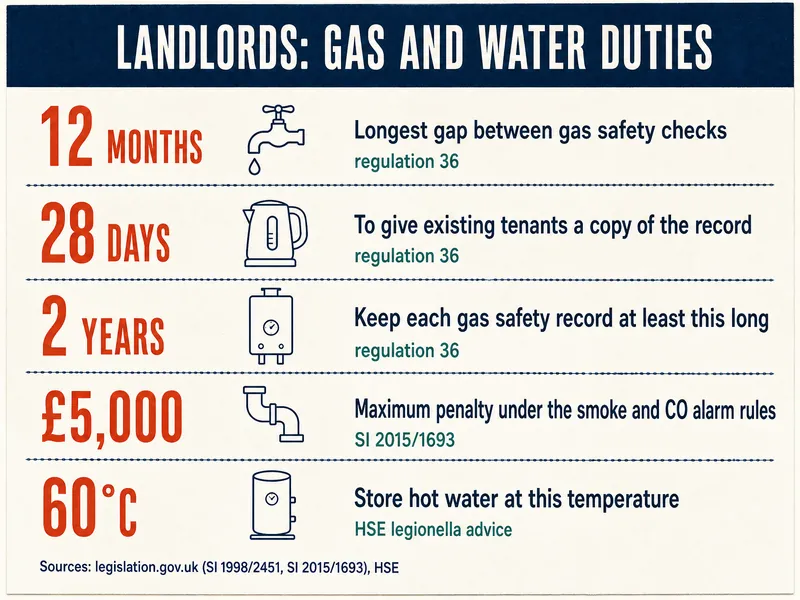
- 12 monthslongest gap between gas safety checksGas Safety Regs 1998, reg 36(3)
- 28 daysto give existing tenants the gas safety recordGas Safety Regs 1998, reg 36(6)
- £5,000maximum penalty charge under the alarm rulesSmoke and Carbon Monoxide Alarm (England) Regulations 2015
- 60 °Chot water storage temperature for legionella controlHSE
How do you check a Gas Safe engineer?
Ask to see the engineer's Gas Safe ID card and check it against the register. The Gas Safe Register's ID card page says each card carries a photo, the business name and registration number, and a unique seven-digit licence number.
Turn the card over, or scroll down a digital card, to see which kinds of gas work the engineer is qualified for; an engineer qualified for boilers may not be qualified for a gas fire. Physical cards carry a hologram and digital cards a QR code. Gas Safe Register says engineers renew their licence every year and their qualifications every five years.
If someone cannot show a valid card, Gas Safe Register's advice is direct: "do not allow them to carry out work at your property". The register also has an online engineer search on its website.
Where these figures come from
This page draws on SI 1998/2451, the 1998 gas safety regulations (regulations 3 and 36, as made), the Smoke and Carbon Monoxide Alarm (England) Regulations 2015 as amended in 2022, and the 1985 Act's section 11, all on legislation.gov.uk; the HSE's pages on gas safety records, who can do checks and legionella for landlords (updated September 2024); Gas Safe Register's ID card page; and Portsmouth Water's leaks page. All of it was checked in October 2026.
Deliberately missing: the Renters' Rights Act 2025 and any Decent Homes Standard for private rentals (no primary page was opened for their dates), electrical safety rules, licensing schemes run by councils, and prices for gas safety checks or risk assessments.
Further questions
Can a landlord do the gas safety check themselves?
Only if they are a Gas Safe registered engineer. The HSE says all checks must be done by one, and regulation 36(3) of the 1998 regulations requires it for the landlord's check.
Does a gas cooker need a carbon monoxide alarm?
Not under the 2015 regulations as amended. The duty bites on rooms with a fixed burning appliance, such as a boiler, gas fire or wood stove.
How long must a landlord keep gas safety records?
Regulation 36 says 2 years from the date of the check. The HSE adds that if a check is done early, records should be kept until two further checks have been made.
Is a legionella test certificate a legal requirement?
No. The HSE says the law does not require a legionella test certificate and testing is not usually needed in homes. A proportionate risk assessment is what the duty asks for.
Who pays to fix a leaking supply pipe in a rented house?
The property owner, as the supply pipe from the boundary is the owner's under Ofwat's guidance. Portsmouth Water's repair contributions do not apply to council or housing association premises.
Does a landlord have to fit a water softener in hard water areas?
No law found requires one. If a landlord fits one, the water company must be told first under the Water Fittings Regulations, and the DWI and Portsmouth Water both recommend leaving the drinking tap on unsoftened mains water (see drinking water taps).
Can a gas safety check be done early without losing the date?
Yes, within limits. The HSE says a check done up to two months before the deadline can keep the original anniversary date, so the 12-month cycle does not creep forward.
Related pages