Do You Need a Separate Drinking Water Tap?
In short
A drinking water tap fed by unsoftened mains is what the DWI, Portsmouth Water and Water Regs UK all advise once a softener is fitted; it is official advice rather than law.
Chalk & Cistern notes · checked and updated
Shop links on this page: Chalk & Cistern is owned by the same people as SoftPro Water Systems and Quality Water Treatment, the two US water-treatment shops linked on this page. They appear only as US reference models, and what a shop says about its products is reported as its claim. How shop links work
On this page
In brief
- The DWI says not to soften the water to the kitchen tap used for drinking and cooking, because most softeners replace hardness with sodium.
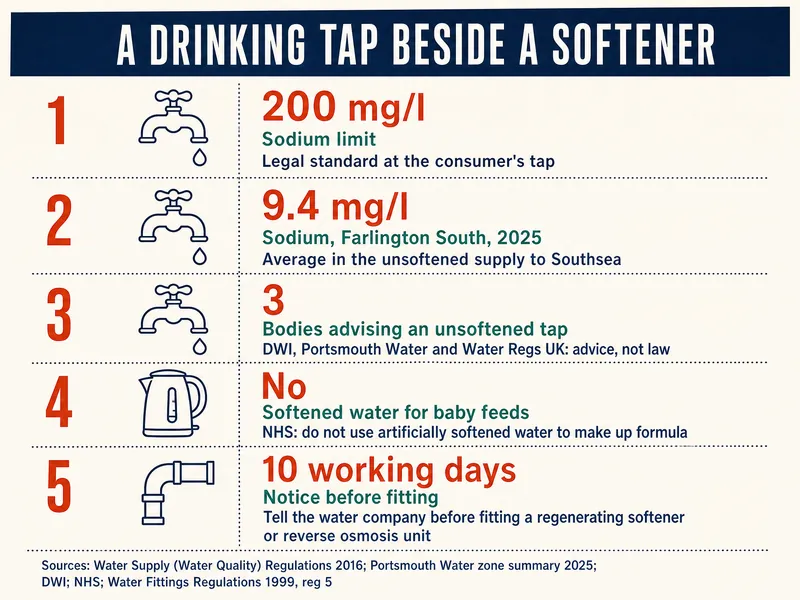
- The legal sodium standard is 200 mg/l at consumers' taps (Water Quality Regulations 2016, Schedule 1); unsoftened water in Southsea's zone averaged 9.4 mg/l in 2025.
- The NHS says not to use artificially softened water to make up baby formula.
- Water Regs UK says a drinking tap with untreated water should "ideally" be kept, but allows whole-house treatment if the water stays wholesome.
- A regenerating softener and any reverse osmosis unit need notice to the water company before fitting, with consent deemed after ten working days (Water Fittings Regulations 1999, reg 5).
- The DWI advises against reverse osmosis water for everyday drinking and cooking, and says RO sends 20 to 30% of the incoming flow to drain.
Do you need a drinking water tap with a softener?
On official advice, yes: keep one kitchen tap on unsoftened mains water for drinking and cooking. The DWI puts it most directly, saying it is "very important" that you "do not soften the water to the tap in your kitchen which is used for drinking and cooking". Portsmouth Water's zone summaries say "If you use a water softener you should retain an un-softened supply for drinking", and its hardness leaflet recommends "a separate unsoftened mains fed tap".
The reason is sodium. The DWI says too much sodium can be a problem for premature babies, whose kidneys are not good at filtering it out, and for people on a low-salt diet. It adds that artificially softened water may be aggressive to plumbing and draw copper and lead out of pipes, which matters in older houses covered on the lead pipes page.
There is a local example. In 2025 a sample in Portsmouth Water's Walderton zone failed for a strong salty taste, and the investigation found "a softened system on the tap" where it was taken; the owner was advised to keep a mains-fed unsoftened drinking supply (Walderton zone summary).
Is a separate tap the law?
No. No regulation says a home with a softener must have an unsoftened drinking tap; the DWI, Portsmouth Water and Water Regs UK all frame it as advice. Water Regs UK says a drinking tap with untreated water should "ideally" be retained, but that whole systems "may be treated" on condition the treated water "remains wholesome".
Two pieces of law sit behind the advice. First, the Water Supply (Water Quality) Regulations 2016 set a sodium standard of 200 mg/l at consumers' taps, and the DWI warns that a softener "may risk breaching this standard". Second, regulation 5 of the Water Fittings Regulations 1999 lists "a water treatment unit which produces a waste water discharge" or uses water for regeneration, which covers a salt softener, and "a unit which incorporates reverse osmosis". Both need notice to the water company and its consent before work begins.
Consent cannot be withheld unreasonably, and if Portsmouth Water has not replied within ten working days it is deemed given. Skipping the notice is an offence under regulation 7, with a fine of up to level 3 on the standard scale. The water regulations page sets out the full list of notifiable work.
Why does softened water carry more sodium?
Because a salt softener works by swapping the calcium and magnesium in hard water for sodium held on its resin. The DWI's filters page says "some water softeners can add significantly to the sodium content of drinking water", and that a softener may change the water's taste and smell as well. The harder the water going in, the more hardness there is to swap.
Portsmouth's water starts low in sodium. The Farlington South zone summary, which covers Southsea, recorded an average of 9.4 mg/l and a highest result of 9.8 mg/l in 2025, against the 200 mg/l standard. Across all 15 zones the averages stayed under 14 mg/l. That is the unsoftened mains; softened water from the same tap would carry the sodium the softener has added.
Drinking water soundings
- 200 mg/llegal sodium standard at consumers' tapsWater Quality Regulations 2016
- 9.4 mg/laverage sodium in the unsoftened Farlington South supply, 2025Portsmouth Water zone summary
- 10working days before consent to a softener or RO unit is deemedWater Fittings Regulations 1999, reg 5
- 20–30%of the incoming flow sent to drain by reverse osmosisDWI
- 1/3rise in a metered water bill an RO unit can cause, at mostDWI
Can softened water be used for baby feeds?
No. The NHS guidance on making up formula says to use freshly boiled drinking water from the tap and "Do not use artificially softened water or water that has been boiled before." The DWI's filters and softeners page says the same: "Artificially softened water should not be used to make up baby feeds."
This is the strongest practical reason to keep an unsoftened tap in a family kitchen. Filling the kettle for a feed from a softened tap is the easy mistake, so the drinking tap should be the one that is most convenient at the sink, and clearly the one meant for the kettle.
Which drinking tap options are there?
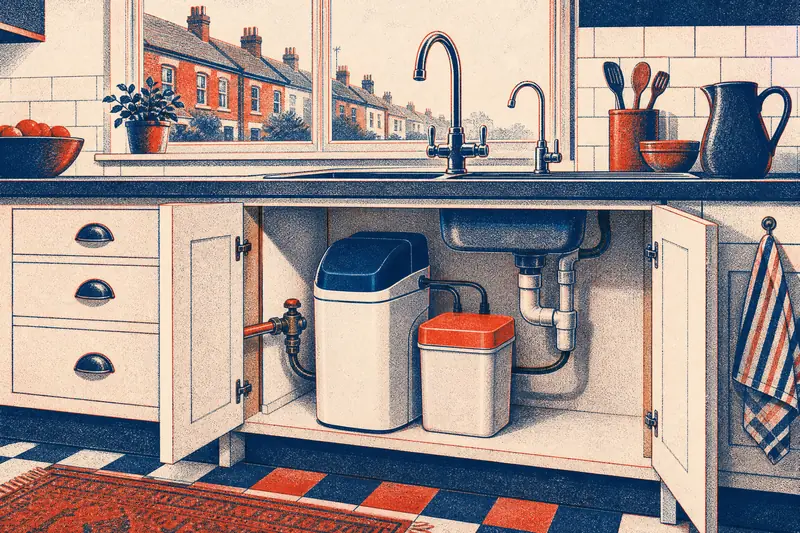
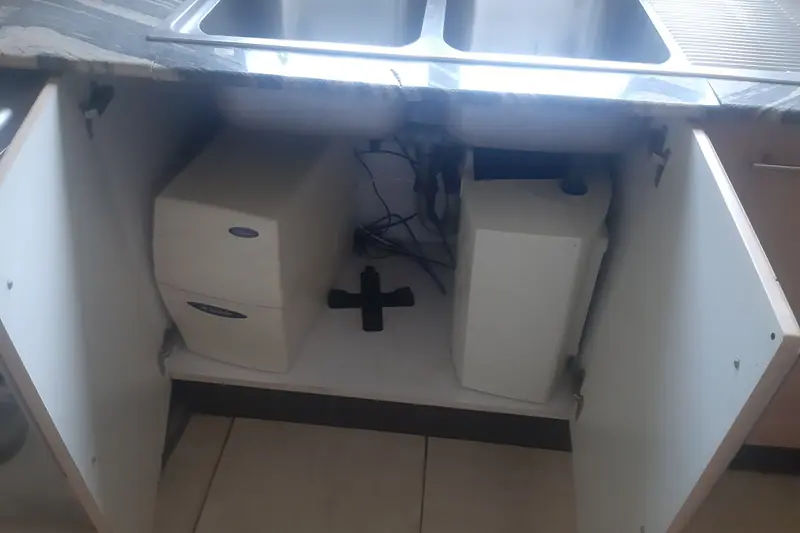
There are three common set-ups: leave the main kitchen cold tap on unsoftened mains, add a small separate drinking tap fed from the mains before the softener, or fit a reverse osmosis unit with its own tap. The first two follow the DWI and Portsmouth Water advice directly. The DWI also asks you to use a qualified plumber and check with the water company in advance that a device meets the fittings rules; WaterSafe lists approved plumbers trained in those regulations.
Reverse osmosis is a different case. The DWI says RO "should be considered only for specialist domestic purposes", that RO water is "not generally considered suitable for drinking and cooking" without minerals added back, and that on a meter the waste can raise bills by up to a third. An RO unit is always notifiable under regulation 5, item 4(e).
For comparison only, two US shops list under-sink RO units with their own tap. The Waterdrop G3P600 (SoftPro Water Systems, a US shop with the same owners as this site) is certified by IAPMO R&T to NSF/ANSI 58 for lead, TDS, fluoride, cadmium, barium and radium reduction (file WC-13976). The Waterdrop G3-W (Quality Water Treatment, a US shop with the same owners as this site) holds NSF/ANSI 58 for TDS, fluoride, cadmium, hexavalent chromium and selenium, but not for lead. NSF/ANSI is a US and Canadian scheme; a UK installation must meet the Water Fittings Regulations and be notified, so look for a unit the installer can show complies. The reverse osmosis page goes further.
| Option | Water at the drinking tap | Notice under reg 5? | What official sources say |
|---|---|---|---|
| Main kitchen cold tap left on unsoftened mains | Unsoftened mains | The softener needs notice; the tap does not | DWI: do not soften the kitchen drinking tap |
| Separate drinking tap on unsoftened mains | Unsoftened mains | As above | Portsmouth Water: separate unsoftened mains-fed tap recommended |
| Whole house softened, no drinking tap | Softened, higher sodium | Yes, for the softener | Water Regs UK: allowed if water stays wholesome; ideally keep a tap |
| Reverse osmosis unit with its own tap | RO water, most minerals removed | Yes, always (item 4(e)) | DWI: RO is for specialist uses; add minerals back if drinking it |
Where these figures come from
The advice comes from the DWI's hard water page and its domestic filters and softeners page (both modified February 2026), the NHS page on making up baby formula (reviewed August 2023), Water Regs UK's softener FAQ, and Portsmouth Water's hardness leaflet and 2025 zone summaries (dated 20 March 2026). The law is the sodium standard in the 2016 Water Quality Regulations and regulations 5 and 7 of the 1999 Water Fittings Regulations, read on legislation.gov.uk in October 2026. The RO units' certification wording follows IAPMO R&T's listing under WC-13976 rather than the shops' pages. Left out: a calculated sodium figure for softened Portsmouth water, which no opened source states, and any claim that a softener or RO unit improves health.
Further questions
Can a softener be fitted to the hot supply only?
Yes. In the DWI's view, softening only the feed to the boiler or cylinder is the more economical way to prevent limescale, compared with softening the whole supply. The cold kitchen tap then stays on unsoftened mains without any extra pipework.
Does a jug filter make softened water fit for drinking?
No source here says so. The DWI's advice is to keep an unsoftened supply to the kitchen tap, not to filter softened water afterwards.
Is boiled softened water all right for a baby's bottle?
No. The NHS says not to use artificially softened water for formula at all, boiled or not, and not to use water that has been boiled before.
Who checks that a drinking tap has been plumbed correctly?
Notifiable work goes to the water company, which can attach conditions to its consent. A plumber in an approved contractor scheme, such as one listed on WaterSafe, can certify that the work meets the fittings regulations.
Can appliances affect water at the kitchen tap?
They can. A 2025 failure in a Southsea property was traced to a washing machine without a double-check valve, and resamples passed once one was fitted, according to Portsmouth Water's Farlington South summary.
Does a drinking tap need its own filter?
Not on the public supply: the DWI says there is no need for extra home treatment as a health protection measure. Some people add a carbon filter for taste, which the DWI says must have its cartridge changed as the maker directs.
What does softened water taste like?
The DWI says a softener may alter the taste and smell of the water, making it less pleasant to drink. Portsmouth Water's Walderton case shows a strongly salty taste can be noticed at a softened tap.
Keep reading