Water Filters: Which Type Does What?
In short
Water filters for the home come in four main types, jug, under-sink carbon, reverse osmosis and whole-house carbon; on Portsmouth's chlorinated mains, most are bought to improve taste rather than safety.
Chalk & Cistern notes · checked and updated
Shop links on this page: Chalk & Cistern is owned by the same people as SoftPro Water Systems and Quality Water Treatment, the two US water-treatment shops linked on this page. They appear only as US reference models, and what a shop says about its products is reported as its claim. How shop links work
On this page
Most people who buy a filter in south-east Hampshire are reacting to one of two things: a chlorine taste, or the chalky film that hard water leaves on a kettle. Those are different problems, and only one of them is what most filters are built for. Chalk & Cistern lines up the four common types against Portsmouth Water's published results and the standards that certify what a filter does.
In brief
- Portsmouth Water disinfects with chlorine, and its 2025 zone summaries show free chlorine averaging 0.39 to 0.54 mg/l at taps.
- Portsmouth Water says most taste complaints it receives are linked to that chlorine dose (water quality page).
- The DWI says there is no need for extra treatment in the home as a health protection measure, and suggests a covered glass jug in the fridge as a cheaper taste fix.
- NSF certifies filters to NSF/ANSI 42 for taste and chlorine, 53 for contaminants with health effects, and 58 for reverse osmosis.
- A unit incorporating reverse osmosis must be notified to the water company under the Water Fittings Regulations 1999, regulation 5.
- The DWI warns that a cartridge not changed when the maker says "may leach other chemicals or bacteria".
Which water filter types are there?
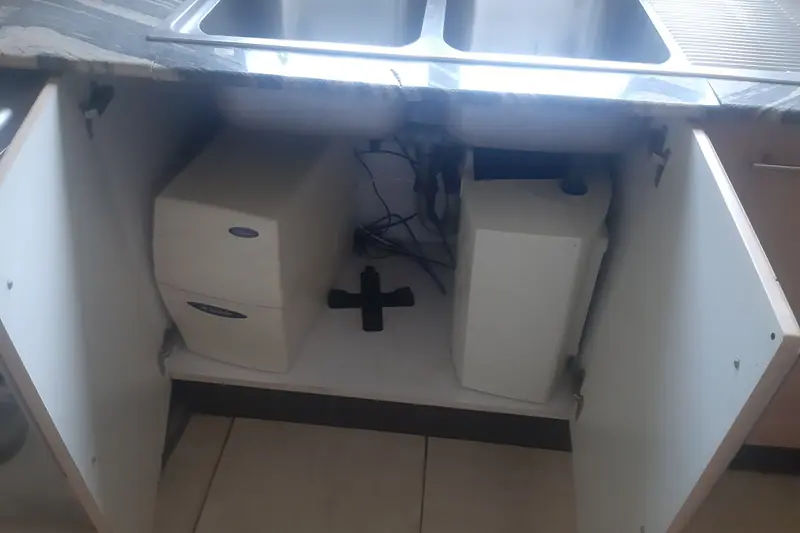
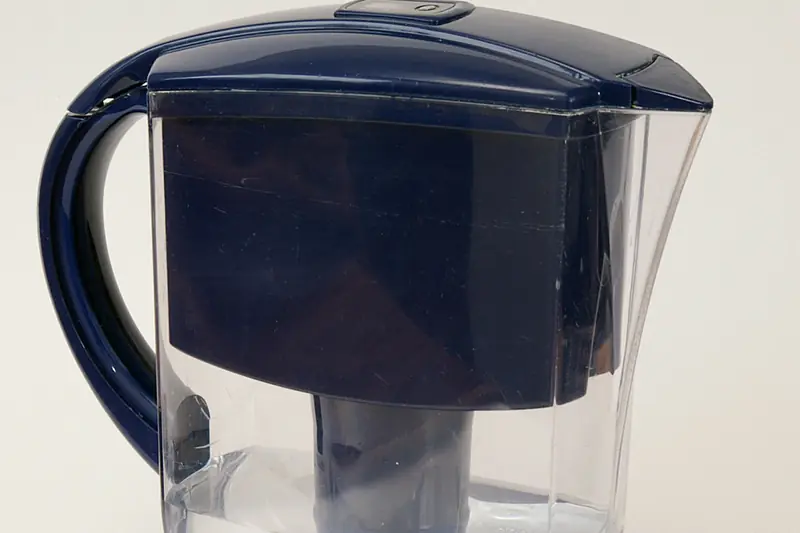
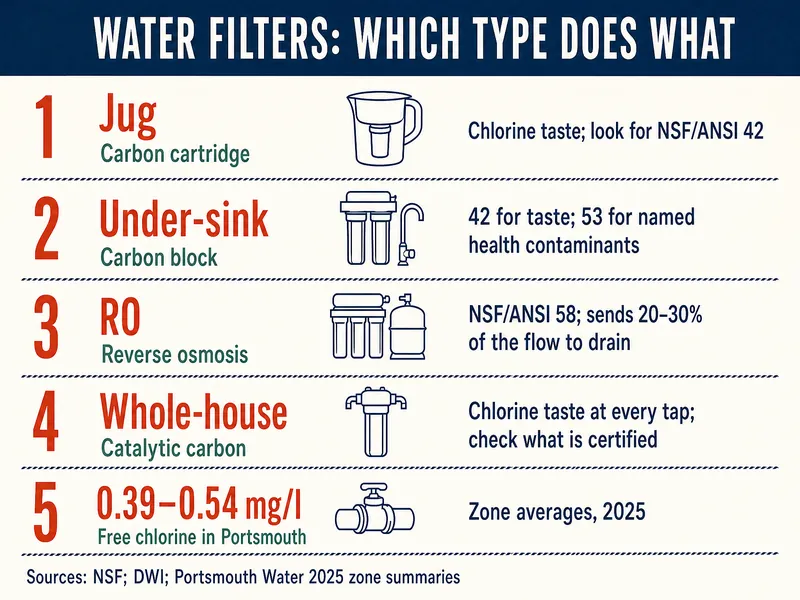
There are four common water filter types for a home: a jug with a carbon cartridge, an under-sink carbon filter feeding the kitchen tap or a small separate tap, an under-sink reverse osmosis unit, and a whole-house carbon filter on the incoming main. They differ less in what the carbon does than in how much water they treat and what paperwork comes with them.
| Type | Treats | Standard to look for | Notice to the water company? |
|---|---|---|---|
| Jug with carbon cartridge | Water poured through it | NSF/ANSI 42 for chlorine taste | No, not plumbed in |
| Under-sink carbon | Kitchen tap or a separate tap | 42 for taste; 53 for named health contaminants | Only if it discharges waste water or needs water to clean itself (reg 5, item 4(f)) |
| Under-sink reverse osmosis | One drinking tap | NSF/ANSI 58 | Yes, item 4(e) |
| Whole-house carbon | Every tap in the home | Check what is certified, not just parts marks | Only if it discharges waste water or needs water to clean itself (item 4(f)) |
| Covered jug in the fridge | Water left to stand | None needed | No |
The last row is not a filter at all, but it is the DWI's own suggestion for chlorine taste. Portsmouth Water adds a limit: keep that water no more than 24 hours, because once the chlorine has gone the water is "no longer protected against bacterial growth".
What does a carbon filter remove?
A carbon filter mainly removes chlorine and the tastes and smells that come with it, which is what NSF/ANSI 42 covers: what NSF calls "aesthetic impurities", such as chlorine, taste and odour. Some carbon blocks are also certified under NSF/ANSI 53 for named contaminants with a health effect, such as particular metals or chemicals; only the certificate tells you which.
A carbon filter is not a softener. NSF certifies softening under a separate standard, NSF/ANSI 44, for units that use a cation exchange resin, so for a furred kettle see the limescale page or the water softeners page.
Portsmouth Water notes that a filter which takes out the chlorine also removes "the protection against contamination", so filtered water should be kept cool and the cartridge changed regularly.
Does Portsmouth water need a filter?
Portsmouth water does not need a filter for safety: it meets the legal standards, and the DWI says filters are not needed as a health protection measure. Whether you want one for taste is a separate question, and chlorine is usually the answer to it.
The DWI says companies typically keep residual disinfectant at 0.5 mg/l or less, and that the World Health Organization's health-based guideline maximum for chlorine is 5 mg/l. Portsmouth Water's 2025 averages of 0.39 to 0.54 mg/l sit around that typical level. It is a regulatory requirement in England and Wales for companies to hold a chlorine residual in the network.
A medicinal or TCP taste is often not the water at all. Portsmouth Water's taste and smell leaflet says chlorine can react with plastics and rubbers in plumbing or appliances to cause it, and the DWI points to appliance hoses as a common cause. A non-return valve on the appliance is the fix, and the leaflet says Portsmouth Water can provide one for most domestic appliances free of charge.
Two cases where a certified filter makes sense: a home that may still have lead pipes (see lead water pipes), and a private borehole or well (see private supplies), which is not treated by a water company at all.
How do you read a filter certification?
Read a filter certification for three things: the exact model, the standard, and the list of contaminants it is certified to reduce. NSF says certification "does not mean" a filter reduces "all possible contaminants", and that the numbers in the standards' names are "not a ranking", so a 58 is not better than a 53.
The certifier matters too. NSF is not the only body certifying to its standards: IAPMO R&T, for example, holds the NSF/ANSI 58 certificates for the Waterdrop RO units sold by the US shops. Marks such as NSF/ANSI 61 or 372 on a part cover materials in contact with water, not what the filter takes out.
These are US and Canadian schemes. In the UK, the DWI says any product has to satisfy regulation 4 of the 1999 fittings rules, with the supplier able to prove it, and Water Regs UK says a certificate on its own cannot prove compliance because so much depends on the installation. The DWI's other advice: never buy from a door-to-door seller, "particularly those offering to test your water".
How often do filters need changing?
Filters need changing as often as their maker says, and no sooner or later. The DWI puts it bluntly: a cartridge not changed on time "will cease to be effective and may leach other chemicals or bacteria".
Write the change date on the unit so the interval is not left to memory. Portsmouth Water gives the same message in shorter form: if you use a filter, "change the cartridge regularly" and keep the filtered water somewhere cool.
Reverse osmosis units have several stages with their own intervals; the reverse osmosis page covers them along with the water they send to drain.
Filter soundings
- 0.39–0.54 mg/lFree chlorine at taps, zone averages, 2025Portsmouth Water zone summaries
- 5 mg/lWHO guideline maximum for chlorineDWI chlorine page
- 24 hoursLongest to keep dechlorinated water in the fridgePortsmouth Water leaflet
- 20–30%Share of the incoming flow an RO unit sends to drainDWI
Which whole-house filters do the US shops list?
Each of the two US shops sells a catalytic carbon whole-house filter. The SoftPro Chlorine+ Carbon Whole House Filter (SoftPro Water Systems, a US shop with the same owners as this site) comes as a 1.5 cubic foot tank (about 42 litres of media), and the Whole House Chlorine+ Filter at Quality Water Treatment (Quality Water Treatment, a US shop with the same owners as this site) in 1.0 and 1.5 cubic foot sizes (about 28 and 42 litres). The shops describe them for chlorine and also for chloramine (the shops' wording); Portsmouth Water disinfects with chlorine, so for a home here the chlorine part of that description is what counts.
No contaminant-reduction certification was found for either filter; the NSF/ANSI 61 and 372 marks on the Quality Water Treatment page cover components and materials. Treat them as US reference models for comparing tank sizes, not as products for a UK home. Any whole-house filter fitted in England must meet the Water Fittings Regulations, and one that backwashes to drain falls under the notification rule, so a UK reader should look for a unit the installer can show complies.
Where these figures come from
Based on Portsmouth Water's water quality page, 2025 zone summaries and taste and smell advice sheet, the DWI's pages on domestic filters and softeners, chlorine, and taste and odour, NSF's guide to water treatment standards, the Water Fittings Regulations 1999 regs 4 and 5, Water Regs UK on compliant fittings, the certification research recorded for the two US shops' products and their listings, all read in October 2026. Left out: the shops' PFAS, percentage-removal and health claims, which no certificate supports; filter prices; and any test of a filter by this site, since none was done.
Further questions
Does boiling water remove chlorine?
The sources opened for this page do not deal with boiling and chlorine. The DWI's suggested taste fix is a covered glass jug in the fridge, which Portsmouth Water says should be used within 24 hours.
Can a filter make tap water less safe?
It can if it is neglected. The DWI warns that overdue cartridges can leach chemicals or bacteria, and Portsmouth Water notes that removing chlorine removes the water's protection against contamination.
Is fluoride added to Portsmouth's water?
No. Portsmouth Water says it does not add fluoride to any of its supplies; it is also absent from the DWI's register of fluoridating water companies.
Do landlords have to fit filters?
None of the regulations behind this page makes a landlord fit a filter. Where a tenancy includes one, agree in writing who changes the cartridges; the legal duties that do exist are on the landlords page.
How do you get a report on your own tap water?
The DWI says you can ask your water company for a free copy of the drinking water quality report for your supply. Portsmouth Water also publishes results for each supply zone online, and offers a free lead test if you think you have lead pipes.
Should a whole-house filter come before or after a softener?
The US EPA's softener guide says it is generally recommended to fit the softener after a whole-house filter, so the water is filtered before it is softened.
Read on