What Size Water Softener Do You Need?
In short
Water softener size comes from three numbers: your zone's hardness, how many litres the household uses and how often you want it to regenerate; on Portsmouth water, four people need roughly 2,650 grains a day.
Chalk & Cistern notes · checked and updated
Shop links on this page: Chalk & Cistern is owned by the same people as SoftPro Water Systems and Quality Water Treatment, the two US water-treatment shops linked on this page. They appear only as US reference models, and what a shop says about its products is reported as its claim. How shop links work
On this page
Softeners are sold by grain capacity, a US unit, while Portsmouth Water publishes hardness in mg/l and bills in cubic metres. Chalk & Cistern works the sum through in British units, using the company's own figures, so you can check the size an installer proposes rather than take it on trust.
In brief
- A softener's rating in grains is the hardness it can remove before it must regenerate: a 32,000-grain unit takes out 32,000 grains per cycle (US EPA WaterSense, 2026).
- One grain is 64.79891 mg under the Weights and Measures Act 1985, so 1 grain per US gallon works out at about 17.1 mg/l.
- Portsmouth Water's 2026 zone averages run from 263 to 310 mg/l; the zone covering Southsea, Farlington South, is 282 mg/l.
- A review for Portsmouth Water put use in its area at 152.5 litres per person per day in 2022–23.
- Four people at that rate use about 610 litres a day, which carries roughly 2,650 grains of hardness.
- At full rated capacity, a 32,000-grain unit would regenerate about every 12 days for that household; the EPA warns against oversizing.
How do you work out water softener size?
You work out water softener size by multiplying daily water use by hardness, converting the result to grains, and choosing a capacity that covers several days between regenerations. The EPA's guide names the two inputs plainly: "the hardness of your water and your household water use".
The sum in four steps:
- Hardness. Find your zone's figure in mg/l as calcium carbonate from Portsmouth Water's 2026 table, or its Zone Lookup for your address.
- Litres a day. People in the house multiplied by litres per person, or your own meter readings divided by the days between them.
- Hardness load. Litres × mg/l gives milligrams of hardness a day; divide by 64.8 to get grains.
- Capacity. Divide a softener's grain rating by the daily load to see how many days it lasts between regenerations.
Leave out water that does not need softening. The EPA suggests discounting garden and outdoor use, and in the UK the kitchen drinking tap is normally kept unsoftened as well (see the drinking tap page).
How much water does a household use?
A household in Portsmouth Water's area uses more than the national pattern suggests: Artesia's review of per capita consumption for Portsmouth Water (September 2023) gives 152.5 litres per head per day for 2022–23, and a three-year rolling average of 161.
That is an area average, not your bill. Since metering is now compulsory in the area, your own readings are the better figure: the meter's black digits are cubic metres, and one cubic metre is 1,000 litres. The water meters page explains how to read one.
For comparison, Approved Document G sets a design limit of 125 litres per person per day for new homes (110 where planning sets the tighter figure). That is a building standard, not a measure of what people actually use, so the worked example below sticks with the measured 152.5.
What size softener for Portsmouth water?
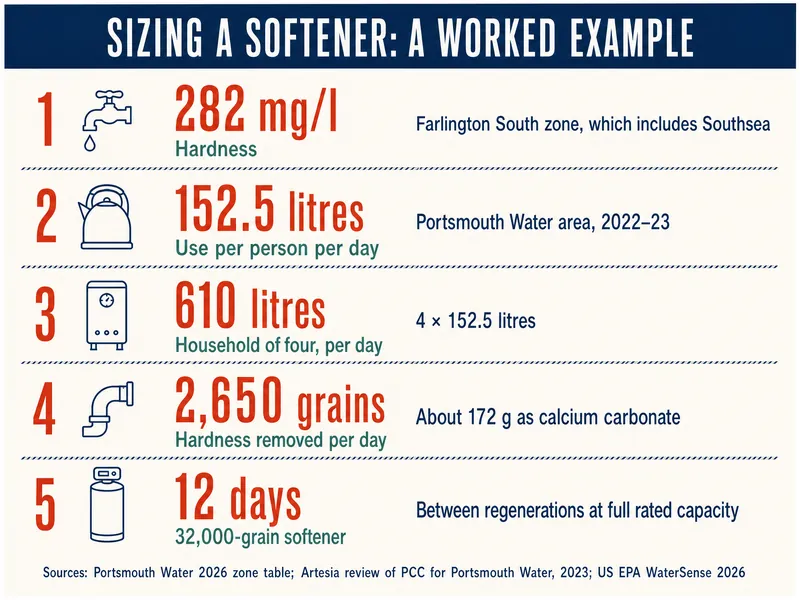
For a four-person household in Southsea, a 32,000-grain softener covers about 12 days at its full rating. The sum: 4 × 152.5 = 610 litres a day; 610 × 282 mg/l = 172,020 mg, or about 172 g of hardness as calcium carbonate; divided by 64.8 that is roughly 2,650 grains a day.
Hardness moves the answer less than household size does. At 263 mg/l, the softest zone (Walderton), the same household needs about 2,480 grains a day; at 310 mg/l, the hardest (Worlds End), about 2,920. The table shows how the days between regenerations change with the number of people.
| Household | Litres a day | Grains a day | 32,000-grain | 48,000-grain | 64,000-grain |
|---|---|---|---|---|---|
| One person | 152.5 | 664 | 48 days | 72 days | 96 days |
| Two people | 305 | 1,327 | 24 days | 36 days | 48 days |
| Three people | 457.5 | 1,991 | 16 days | 24 days | 32 days |
| Four people | 610 | 2,655 | 12 days | 18 days | 24 days |
| Five people | 762.5 | 3,318 | 9.6 days | 14.5 days | 19 days |
Bigger is not better. The EPA says "It is important not to oversize your system", because it wastes water. The rated grain figure is also the most a unit can do per cycle; how much it achieves depends on the salt setting, so ask the installer what capacity they have programmed and at what salt dose.
Sizing soundings
- 282 mg/lHardness in Farlington South, which includes Southsea, 2026Portsmouth Water zone table
- 152.5 litresUse per person per day in the Portsmouth Water area, 2022–23Artesia for Portsmouth Water
- 64.79891 mgOne grain, by lawWeights and Measures Act 1985, Sch 1
- 3,350Grains of hardness per pound of salt, the EPA's efficiency floorUS EPA WaterSense
What does flow rate mean for a softener?
Flow rate is how many litres a minute can pass through the softener while it still softens properly and without a big drop in pressure; it matters as much as grain capacity in a house where two showers run at once. Neither US listing linked on this page states a service flow for its softeners, so ask the installer for the unit's rated flow in litres per minute.
Portsmouth Water gives a yardstick for the incoming supply on its leaks, pressure and pipes page: its minimum standard is 1 bar at its stop tap, with flow enough to fill a 9-litre bucket in about a minute, and a 1-litre jug filled from the cold kitchen tap in under 7 seconds means flow is fine. A softener sized well for capacity but too small for flow will show up as weak showers.
If a booster pump is part of the plan, note that a pump or booster drawing more than 12 litres a minute is itself notifiable under regulation 5 of the Water Fittings Regulations, as is the regenerating softener.
How often should a softener regenerate?
A softener should regenerate only when its capacity is nearly used, not on a fixed daily timer. The EPA recommends demand-initiated regeneration, where a meter or hardness sensor triggers it, and says "You probably don't need to schedule regeneration every day", because regenerating too often wastes salt and water.
For the four-person example, a meter-controlled 32,000-grain unit would regenerate roughly every 12 days at full rating, more often at a lower salt setting. A model meeting the EPA's efficiency criteria uses at least 3,350 grains of exchange per pound of salt and no more than 5 US gallons (18.9 litres) of water per 1,000 grains. On those limits, the example household would use at most about 130 kg of salt a year and about 50 litres of regeneration water a day, roughly 18 cubic metres a year.
That water goes to drain on a metered bill, and sewerage is normally charged on 92.5% of metered use, so efficiency shows up twice. The water softeners page covers running costs and the rules on fitting.
Which sizes do the US shops list?
The SoftPro Elite Smart HE (SoftPro Water Systems, a US shop with the same owners as this site) is listed in 32,000, 40,000, 48,000 and 64,000-grain sizes, and the Elite HE listing at Quality Water Treatment (Quality Water Treatment, a US shop with the same owners as this site) offers the same four. Using the table above, a four-person household on 282 mg/l water would see roughly 12, 15, 18 or 24 days between regenerations at each rating. These are US reference models for comparing sizes, not products for a UK home.
A softener fitted in England must meet the Water Fittings Regulations and be notified to the water company before work starts, so a UK reader should look for a unit the installer can show complies.
Where these figures come from
This page uses Portsmouth Water's 2026 hardness table (WQ 09 04 15), the Artesia Consulting review of per capita consumption prepared for Portsmouth Water (report AR1545, 26 September 2023), Portsmouth Water's metering and pressure pages, the US EPA WaterSense softener guide (May 2026), the Weights and Measures Act 1985 Sch 1, Approved Document G (2015 edition with 2016 and 2024 amendments) and the Water Fittings Regulations 1999 reg 5, read in October 2026. The grain, salt and water figures in the worked example are this site's arithmetic from those sources (1 US gallon = 3.785 litres; 1 pound = 0.4536 kg). Left out: softener prices beyond the listings, salt prices, and any claim that one size suits every home.
Further questions
Is a bigger softener a safer choice?
No. A unit far larger than the household needs regenerates rarely, and the EPA says oversizing leads to inefficient water use. Size it on measured use with a sensible margin, and let a demand-controlled valve decide when to regenerate.
Does a household with a drinking tap need a smaller softener?
Slightly. The water drawn from an unsoftened kitchen tap never passes through the resin, so it can be taken out of the daily total, along with garden use.
How do you convert Clark degrees into grains?
Portsmouth Water's tables pair about 14.3 mg/l with each Clark degree, and a grain per US gallon is about 17.1 mg/l. Converting through mg/l is simplest: 282 mg/l is about 20 °Clark or about 16.5 grains per US gallon.
Should a softener be sized on the highest zone figure?
Use your own zone's figure from Portsmouth Water's Zone Lookup. Across the 15 zones the averages differ by under a fifth, from 263 to 310 mg/l, so household size and water use usually matter more.
Do the grain sizes on US listings mean the same thing in the UK?
The grain is the same unit on both sides of the Atlantic, but the gallon is not. US listings use the US gallon of 3.785 litres; an imperial gallon is 4.546 litres.
Will a home with a combi boiler need a different size?
No. The softener treats the cold mains before it reaches the boiler; size depends on total softened water use, not the type of boiler. The combi boilers page covers what makers say about softened water and the heating circuit.
Read on
Back to the Chalk & Cistern front page