Water Regulations for Home Plumbing
In short
Water regulations for home plumbing in England are the Water Supply (Water Fittings) Regulations 1999: fittings must not waste or contaminate mains water, and some work needs the water company's consent first.
Chalk & Cistern notes · checked and updated
On this page
In brief
- England's 1999 water fittings rules (SI 1999/1148) ban any fitting that causes waste, misuse, undue consumption or contamination of mains water, or wrong meter readings.
- Some work must be notified to the water company first: baths over 230 litres, pumps drawing more than 12 litres a minute, reverse osmosis units and regenerating water treatment units are on the list (regulation 5).
- After notice, Portsmouth Water gets ten working days in which it may say no or set conditions; silence counts as consent.
- Schedule 1 sorts water and other fluids into 5 categories, from wholesome mains water (category 1) to a serious health hazard (category 5).
- Breaking the rules is a criminal offence; magistrates can impose a level 3 fine (regulation 7).
- Work by an approved contractor, who certifies that it complies, gives the owner a legal defence.
What do the water regulations cover?
The water regulations cover every pipe, tap, cistern and appliance connected to the mains supply, from the boundary stop tap to the last outlet. The core rule, in regulation 3, is that no water fitting may be installed, connected, arranged or used so that it causes or is likely to cause "waste, misuse, undue consumption or contamination" of water supplied by a water undertaker, or "the erroneous measurement of water".
Regulation 4 adds that every fitting must be "of an appropriate quality and standard" and "suitable for the circumstances in which it is used". Schedule 2 then sets out the detail: pipes protected against freezing, cold-water pipes kept from warming above 25 °C where reasonably practicable, a stopvalve for each separately occupied home, and backflow protection.
In the Portsmouth area the water undertaker is Portsmouth Water, which supplies about 740,000 people. It is the body you notify under regulation 5 and the one that gives or conditions consent.
Water Regs UK, the organisation behind the WRAS approvals scheme, explains on its compliant fittings page that a fitting can show it meets regulation 4 by conforming to an appropriate British Standard or to a specification approved by the regulators. It also warns that, in isolation, certification "cannot be relied upon" to prove compliance, because where and how the fitting will be installed is unknown.
Which work must you notify first?
Regulation 5 lists the work you must tell the water company about before you start. You give notice, then wait: the company has ten working days to refuse consent or set conditions, and if it says nothing in that time, consent is deemed granted unconditionally. Consent "shall not be withheld unreasonably".
| Work or fitting | Threshold or detail | Approved contractor exempt? |
|---|---|---|
| New building or structure | Any, except a pond or swimming pool | No |
| Altering a water system | Premises other than a house | Yes |
| Material change of use | Any premises | No |
| Bath | More than 230 litres | No |
| Bidet | With an ascending spray or flexible hose | Yes |
| Pump or booster | Drawing more than 12 litres a minute | No |
| Reverse osmosis unit | Any unit that incorporates it | No |
| Water treatment unit | Produces a waste discharge or uses water to regenerate or clean | No |
| Reduced pressure zone valve | Or another category 4 or 5 mechanical device | Yes |
| Garden watering system | Unless operated by hand | No |
| Pipes laid outside a building | Less than 750 mm or more than 1,350 mm deep | No |
| Pond or pool | Over 10,000 litres, refilled automatically from the mains | No |
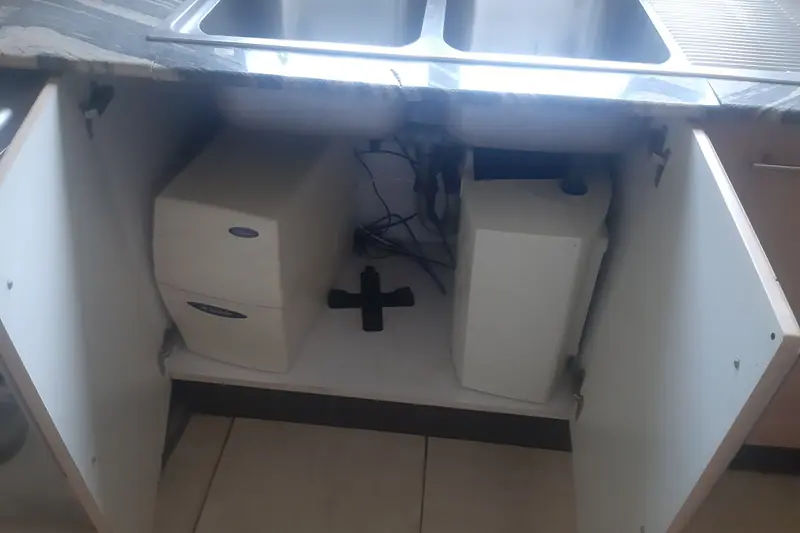
Two lines matter most in hard-water south-east Hampshire. A salt softener regenerates with water and sends brine to drain, so it falls under the water treatment unit item; a reverse osmosis unit is named outright. The water softeners and reverse osmosis pages cover those fittings in detail.
For the purely domestic jobs, such as swapping a tap or a WC, there is no notice to give. Water Regs UK is clear that this does not lift the rules: there remains "a legal obligation for the installer and premises owner or occupier" to make sure the work complies.
What is an approved contractor?
An approved contractor is a plumber registered with a scheme recognised for the water regulations, who can certify that work complies. Water Regs UK's approved contractors page describes the schemes as "voluntary organisations for plumbers and plumbing contractors", whose members send a certificate of compliance to the water company "as well as issuing one to their client".
That certificate does two things. Under regulation 5(2), work by an approved contractor on three items in the table (altering a system in premises other than a house, a bidet with an ascending spray or flexible hose, and a category 4 or 5 mechanical backflow device) needs no advance notice. Under regulation 7(2), it is a defence if the work was carried out by or under the direction of an approved contractor who certified that the fitting complied.
WaterSafe is the national register that lists approved plumbers from the recognised schemes (APHC, CIPHE, SNIPEF and WIAPS) in one search. It calls its members professionals "trained in Water Fittings Regulations", and the Met Office describes it as backed by all UK water companies and the drinking water regulators.
What is backflow and why does it matter?
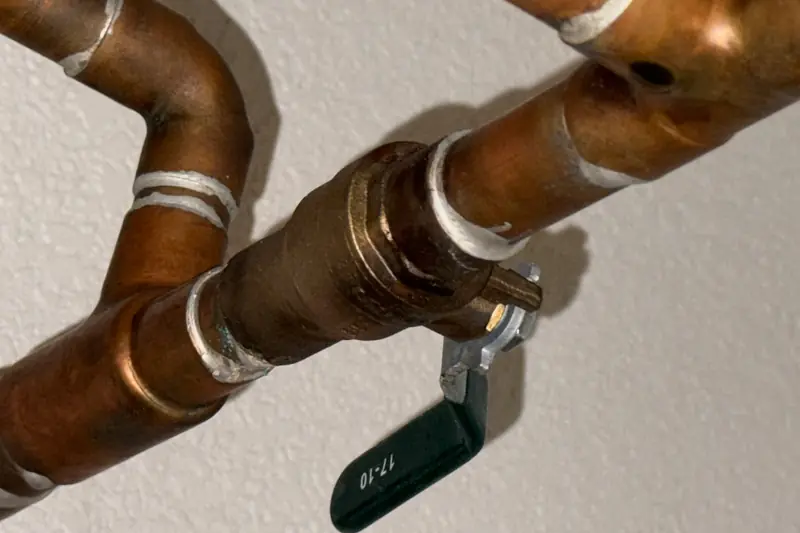
Backflow is water flowing the wrong way, out of an appliance, cistern or hose and back into the pipes that feed drinking taps. Schedule 2, paragraph 15 requires every water system to contain "an adequate device or devices for preventing backflow of fluid from any appliance, fitting or process".
The device has to match the risk. Paragraph 15(3) says it must be "appropriate to the highest applicable fluid category" downstream. Schedule 1 defines five categories:
- Category 1: wholesome water supplied by a water undertaker.
- Category 2: that water with its aesthetic quality impaired, by a change in temperature or in taste, odour or appearance.
- Category 3: a slight health hazard from substances of low toxicity.
- Category 4: a significant health hazard from toxic substances, such as chemicals or pesticides.
- Category 5: a serious health hazard from pathogens, radioactive or very toxic substances, including faecal material.
Paragraph 15(4) also requires backflow protection on a pipe where it is needed to protect separately occupied premises from each other, which is why flats and converted houses get extra attention. Treatment kit is one practical risk: the Drinking Water Inspectorate says incorrectly installed or faulty softeners, treatment devices and filters "may result in backflow of water with added salt in it". Chalk & Cistern does not assign a category to softener brine, because no opened source does.
The water fittings rules in figures
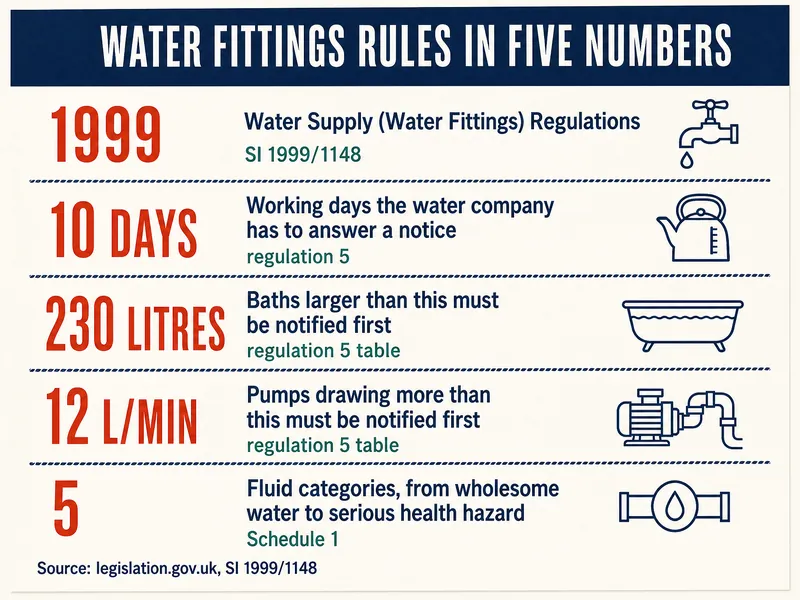
- 10 working daysfor the water company to answer a noticeWater Fittings Regulations 1999, reg 5
- 230 litresbath size above which notice is neededWater Fittings Regulations 1999, reg 5
- 12 litres a minutepump draw above which notice is neededWater Fittings Regulations 1999, reg 5
- 5fluid categories in Schedule 1Water Fittings Regulations 1999, Sch 1
What happens if fittings break the rules?
Contravening the water regulations is a criminal offence. Regulation 7(1) says a person who breaks them is liable on summary conviction to a fine not exceeding level 3 on the standard scale.
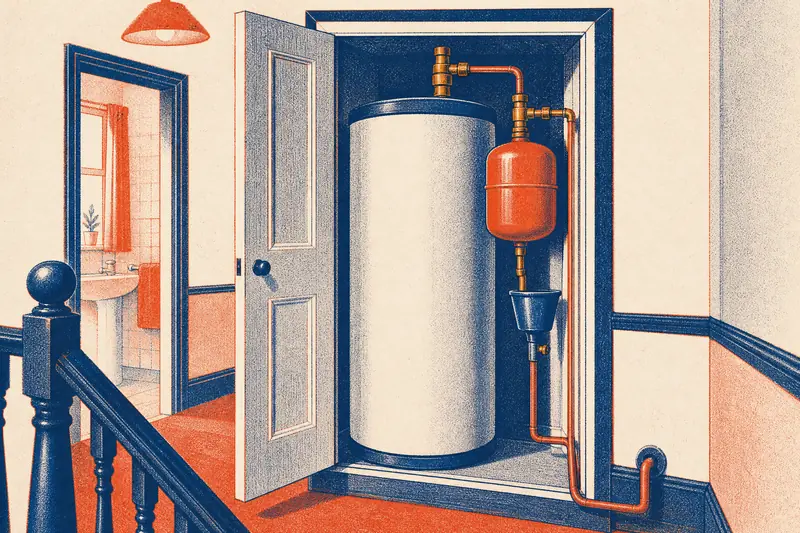
The practical consequence often comes sooner. On a leaking supply pipe, Ofwat notes that the company may issue a legal notice under the Water Industry Act 1991 and, if the work is not done in time, carry it out and pass on the cost. Unvented hot-water cylinders bring a second set of rules under the Building Regulations, covered on the unvented cylinders page.
Do the rules affect a water meter or a leak?
Yes, in two ways. Regulation 3 forbids any fitting that causes wrong measurement, so nothing may bypass a meter; the water meters page explains how readings and bills work. And the owner's duty to keep fittings from wasting water applies to a leaking supply pipe, which the water leaks page covers.
Where these figures come from
This page is based on SI 1999/1148 (regulations 3, 4, 5 and 7, Schedules 1 and 2) on legislation.gov.uk; Water Regs UK's pages on compliant fittings and approved contractors; WaterSafe's home page; the Drinking Water Inspectorate's taste and odour page (2024); Ofwat's supply pipe guidance; and Portsmouth Water's Key Facts. Every document was read in October 2026.
Not included: which check valve suits which fluid category (Water Regs UK's page on this could not be opened), any fluid category for softener brine, and fees for approved contractors or inspections, none of which were sourced.
Further questions
Do the water regulations apply to a house built before 1999?
They apply to fittings installed, altered or used now, whatever the age of the house. Older pipework is not automatically unlawful, but anything you add or change must comply, and no fitting may cause waste or contamination.
Do you need to notify Portsmouth Water before fitting a water softener?
Usually yes. A softener that uses water to regenerate is a water treatment unit under regulation 5, so notice goes in before the work starts. The company then has ten working days to respond.
Is a WRAS-approved product automatically compliant?
Not on its own. Water Regs UK says certification cannot be relied on in isolation, because compliance also depends on where and how the fitting is installed.
Who checks that fittings comply?
The water company for the area, which for most of south-east Hampshire is Portsmouth Water. It receives notices under regulation 5 and can refuse consent or attach conditions within ten working days.
Does a garden hose need a backflow device?
Schedule 2 requires backflow protection matched to the fluid category, and a hose left in a pond or bucket is exactly the risk it targets. A garden watering system not operated by hand is also notifiable under regulation 5.
Do flats have extra rules?
Yes. Each separately occupied home needs its own stopvalve, and a shared pipe needs one each occupier can reach (Schedule 2, paragraph 10). Backflow protection between separate premises is required where needed.
Can a landlord be liable for a tenant's fittings?
The regulations put the duty on whoever installs or uses a fitting and on the owner or occupier. The landlords page covers the separate repair duty for water installations.
Related pages